
Hammersmith, located just under 5 miles (8 km) to the west of central London, has emerged as a base for several life science occupiers supported by a number of factors, including good public transport access to the City, West End and Heathrow, proximity to Imperial College London and White City Place campus, and relatively lower rents when compared with King’s Cross Knowledge Quarter.
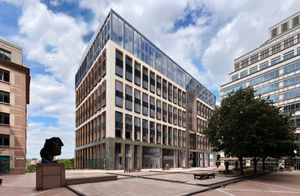
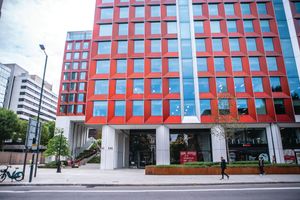
245 Hammersmith Road, a 50/50 joint venture development by Legal & General Assurance (Pensions Management) Ltd and Mitsubishi Estate London Limited, comprises 242,000 sq ft (22,484 sqm) over 11 floors with a gym and retail services at ground level and serviced offices on the lower floors. It is a redevelopment of the old Bechtel House, which dated back to the 1960s, and was launched in 2019.
The building provides flexible, collaborative space and now hosts three life science tenants: macrophage cell therapy company Resolution Therapeutics, biopharmaceutical business Achilles, and therapeutics and gene and cell therapies developer Orchard Therapeutics.
In 2022, Lambert Smith Hampton (LSH) project managed the conversion of office space on the third floor of 245 Hammersmith Road to deliver a new HQ and R&D facility for Orchard Therapeutics who agreed a 10-year lease with an option to break after five years. We spoke with Dudley Cross, National Head of Building Consultancy at LSH to better understand the client brief and any specific challenges that had to be addressed with this project.
What was the client brief for the new space?
Orchard Therapeutics’ objective was to achieve a state-of-the-art office and lab facility that provided light, open space, with plenty of natural daylight to, firstly, provide first class lab accommodation and, secondly, help to build relationships between the office function and science operation. They were seeking better business integration and sought to create a more collegiate feel amongst the workforce.
Were there any specific challenges associated with this conversion?
We were dealing with a multi-tenanted building, so there needed to be minimal disruption to other occupiers The building itself was also brand new with no previous occupant so when undertaking the conversion works we had to be aware of warranties in place for elements such as the cladding, glazing, M&E, curtain walling etc.
The client selected the third floor, which was the most suitable to optimise their required layout. This posed some particular problems around ventilation and plant. The plant decks were on level 10 and on the roof, effectively level 12. So, dealing with ventilation and extraction at such a distance from the third floor was quite a challenge. This is where it’s always helpful to have a willing and supportive landlord, which L&G and Mitsubishi were.
Given that this is a Grade A building, raised floors and suspended ceilings were in place and there were no issues to consider with the floor to ceiling heights. Challenges around ventilation, waste disposal, power, and other factors that you would associate with a building not originally designed for labs were overcome. Nothing is insurmountable if you put your mind to it. On power, we secured the supply capacity required and reserved sufficient capacity from the back-up generator, with the support of the landlord, which we linked to our own uninterruptible power supply (UPS).
We had to obtain planning consent for the ventilation extract and plant. We worked with the provider of the original curtain walling to complete amendments to the building envelope in order to maintain warranties and guarantees.
There were, of course generic challenges, such as creating safe storage for hazardous materials and gases in demised areas, considering safe deliveries, management of goods lift services and, waste away provision, where we had to line the existing drainage outlet to protect against corrosive materials.
Did you use a specialist fit-out contractor?
On this scheme we worked with Bulb Laboratories, who have been providing specialist laboratory services to leading organisations since 2006. Importantly, Bulb employs experts from a scientific background who speak the same language as the client; this helps hugely in interpreting and understanding the client requirements quickly. This will include getting under the skin of the research and processes to be undertaken which, in turn, contributes to designing the right type of lab(s) with the right facilities and correct levels of containment. Selecting the right contractor is critical on these projects.
The third floor is about 20,000 sq ft (1,858 sq m) in size and about 17,382 sq ft (1,635 sqm) of that has been used for a mix of lab and office space in a 60:40 ratio. The remaining space allows access to risers and distribution points. The laboratory areas include general purpose labs, compliant CL2 research labs, and a production room with space for a bioreactor.
Are there any design elements that stand out?
As mentioned, the client wanted to create a light, open feel to the working environment. The design incorporates a lot of glazing, internally and externally, to allow observation of some of the lab space from the office area. This is something that the client is really proud of as it provides potential investors with a real time view of the R&D being undertaken. It also connects the office staff and the science practitioners who, previously, were located in two separate buildings. The result is much improved integration and collaboration across the business.
Did you build in any future adaptability to the scheme?
We worked with the client on a plan to satisfy their immediate day one usage, their five-year usage plans and also, to provide flexibility beyond this. In an ever changing environment it’s important to build flexibility into any design of this nature so, yes, there is the potential to flex the space and expand the lab capacity over time, if required.
Any other comments?
I think it’s noticeable that the landlords, L&G and Mitsubishi, are keen to create a sense of community amongst the wide range of tenants in the building and other nearby occupiers. To this end, 245 Hammersmith Road offers roof terraces, event space, co-working space and pop-ups for tenants, and year-round events in the Urban Park and Podium accessible to all to generate the vibrancy and crossover sought by many young professionals and businesses in the science, tech, and creative sectors.