
Bakar BioEnginuity Hub in California
The former Berkeley Art Museum and Pacific Film Archive or BAMPFA for short was transformed into a new life sciences lab on the campus of University of California, Berkeley (located in Oakland in the San Francisco Bay Area).
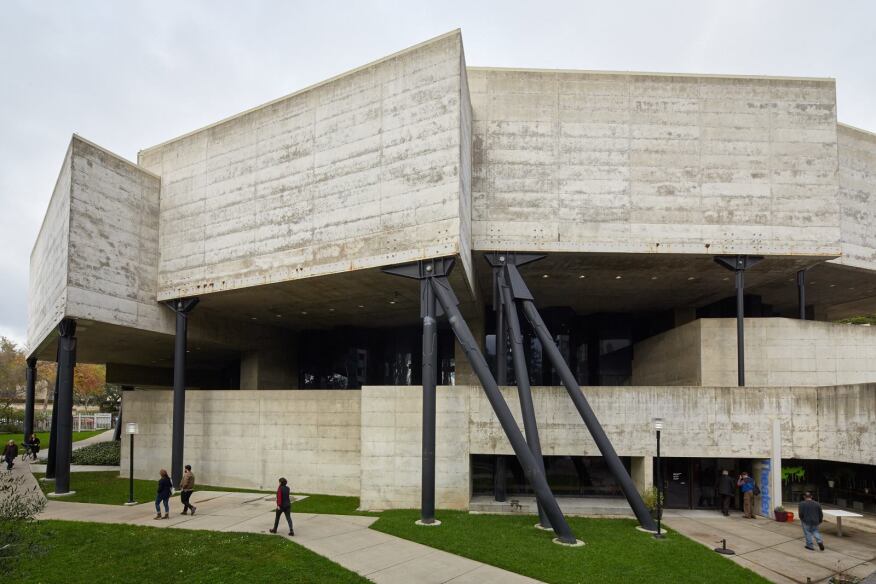
Brutalist style - concrete everywhere
The museum was built in 1970 in the brutalist style. Brutalist buildings are characterised by liberal use of concrete as well as a monolithic and geometric appearance. The term brutalism derives from “béton brut”, French for raw concrete. European examples of the brutalist style include the Barbican Centre in London built in 1982 and the Torres Blancas apartment buildings in Madrid built in 1969.
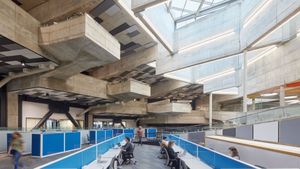
This particular brutalist building was described as “bunker-like” and a “distinctive concrete stronghold ”. Seen from above, the building looks like a handheld fan. Inside, cantilevered balconies and terraced ramps dominate.
Structurally unsound against earthquakes
The building was vacated in 2014 when it was deemed structurally unsound against earthquakes. It remained closed for several years but then reopened in late 2021 after a retrofit and redesign effort that took two years. The repurposed building now includes a laboratory, open office areas, collaboration spaces, conference rooms, an auditorium, an undergraduate programme space, terraces, and public outdoor spaces. The building itself was renamed the Woo Hon Fai Hall and it houses the Bakar BioEnginuity Hub, a 40,000 sq ft (3,700 sq m) incubator.
Specific challenges to overcome
Significant issues, such as seismic performance, water intrusion, and acoustic performance, had to be addressed while bringing the building up to the latest planning standards. The design team also wanted to challenge the often sterile-looking design of lab spaces. Natural light was admitted by uncovering the skylights that had been covered to protect artwork from UV damage. An additional space was required to accommodate the new use and the architects added a 6,600 sq ft (613 sq m) glass front to create a visually distinct appearance that was complementary to the original structure.
The repurposing work required renovation of the mechanical, electrical and plumbing infrastructure, including the replacement of the existing gas service with all-electric systems, allowing the project to achieve operational carbon neutrality as well as meeting LEED Gold requirements. The building is nearly all concrete, including floors, walls, and ceilings, so a major challenge was to make all upgrades, including new modern lighting while cutting into the original structure as little as possible.
Well-equipped research space for young companies
The Hub aims to bridge the gap between Berkeley’s graduate students, life science startups, and established biotech companies by providing well-equipped research space, which is often too costly for young companies. It describes itself as a “home for entrepreneurs, and for the entrepreneurs in the making” which brings together “four essential elements: world-class incubator space, patient capital, distinguished mentors, and vibrant founder communities”.
The adaptive reuse of this brutalist building transformed the concrete monolith, which had been off-limits for the better part of a decade, into lab space and resources that can support a community of up to 80 early-stage companies.