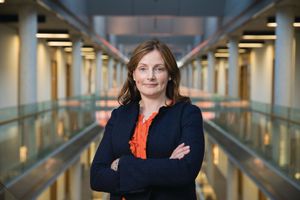
Dr Karen English has been an Associate Professor in the Biology Department of Maynooth University near Dublin since 2020.
In May 2022 Science Foundation Ireland awarded €4.8 million in research funding to Dr English and her colleagues to cover a variety of research projects. The project led by Dr English focuses on a cell-based therapy – mesenchymal stromal cells (MSC) – that is being investigated as a treatment
for patients suffering from acute respiratory distress syndrome.
Congratulations on your recent funding from Science Foundation Ireland. How is the research going?
Acute respiratory distress syndrome (ARDS) is a complex and very serious disease, which has mortality rates of 30 to 40%.For example, many of the worst affected COVID patients,those who are in Intensive Care Units,
suffer from ARDS.The virus makes the patient’s immune system go into overdrive and this puts severe pressure on the lungs.The treatments available at present are limited so this is an unmet clinical need. Our research is investigating ways to calm the immune system down using MSC, which are found in bone marrow. This avenue looks promising but in clinical trials, there is great heterogeneity in how individual patients react to these cells. Our research challenge is to work out why some patients respond favourably while others do not. If we can get to the bottom of this a more successful cell therapy treatment is possible.
You have also done extensive research on graft vs host disease (GVHD) – can you tell us about that?
The best explanation is an example. One way of treating blood cancer is to repopulate the patient’s blood system with stem cells derived from bone marrow or blood. The donor of the cells is always genetically different to
the recipient because we all have a different genetic makeup. What can happen is that the donor’s cells (the graft) view the patient’s
healthy tissue (the host) as foreign, and attack and damage them. So this is the opposite of the more widely known transplant rejection problem, where the host, the recipient of the transplant, fights back. Severe cases of GVHD are extremely serious, with mortality rates of 70 to 80%.The link between the two research areas, ARDS and GVHD, is the reaction of an over-zealous immune system.
Among all the scientific innovations that have come out of Maynooth University, is there one of which you are particularly proud?
We are very proud of Avectas, whose non-viral, cell engineering technology allows efficient transfer of genetic material into cells whilst keeping very high levels of cell viability and functionality. Dr Shirley O’Dea, based here in our business incubator called MaynoothWorks, founded the company in 2012 and is the Chief Scientific Officer there. I have no direct involvement with Avectas.
How can the physical/built environment encourage better innovation among scientists?
A building that is consciously designed and configured for collaborative work will lead to better innovation. Close proximity to other scientific disciplines and having the opportunity to interact is very important. What works particularly well is “walking past space,” where casual exchanges are facilitated.Generously proportioned coffee areas and big spaces for brainstorming are good too. You are much more likely to have a “light bulb moment” when you can get out of your tunnel, so to speak, and work across disciplines.
How could the life sciences and real estate sectors work better together?
When a building is being designed, it is important to ask questions such as: who will be in the building? What are their requirements (that is, what do
they need the building to do for them?) How can the building be configured to be future proof (in other words, to accommodate future technologies)? Listening to the scientists is the key. In terms of specific features of a
science building, try to be modular in design to allow for change.Centralise the shared resources such as fume hoods and keep any laser equipment on the ground floor for maximum stability. Make sure to consider accessibility and bench heights too because diversity and inclusion are as
important in science as elsewhere.
If you had unlimited money but limited space (no more than 1,000 square metres), what would you build?
I would like to have the instrumentation and equipment centralised and available in different configurations to ease inter-disciplinary collaboration. I am no architect but maybe a circular low-rise building with
individual laboratories along the perimeter and a big adaptable central space would work. Adaptability is important, because the work is varied (for examples, sometimes using animals but not always) and you need to future
proof too by providing a space that can accommodate different skill sets and technologies as they emerge.
In terms of driving innovation, how important is cross-discipline cooperation?
It is really important because innovation happens at the intersection of different disciplines. The disciplines in question can be drawn from a very wide spectrum ranging from biology to engineering to psychology and IT. Our final year students work on crossdisciplinary projects with highly diversified skill sets and it is really beneficial for them.