

Amsterdam Life Sciences District
Focus: High-tech medical research
Amsterdam Life Sciences District is located in the South East of Amsterdam. At the heart of the district is the Amsterdam Medical Center (AMC) on the Meibergdreef. The AMC is part of the Amsterdam University Medical Center (UMC), a world-leading academic hospital, which also includes the VU Medical Center (VUMC) which is located in the Innovation District Zuidas.There are several institutions present at the AMC location, such as the Tytgat Institute for Liver and Intestinal Research, and the Amsterdam Skills Center that opened in 2019. Every year, 4,000 surgeons from more than 60 countries are trained at the AMC, where they are currently rolling out the next generation of medical learning platforms.In 2022 the UMC and the City of Amsterdam started the development of a new park on the grounds of AMC, called “Medical Business Park”. With a development area of 100,000 sq m (1.1 million sq ft) where medical companies and research institutions can work and collaborate. The first building of the new park shall be developed and managed by Kadans Science Partner as Plus Ultra Amsterdam, a multi-tenant building offering 8,250 sq m (89,000 sq ft) of office space and laboratories (approximately 50 per cent of each).It offers room for development and innovation of companies and institutions in the medical sector within the reach of start-ups and growth companies. This increases the chance of scientific and commercial breakthroughs and offers starters more opportunities to grow into mature companies. Kadans and AMC will work together in selecting the right tenants.Another dominant part of the Amsterdam Life Sciences District is the Amsterdam Health and Technology Center (AHTC) located on Paasheuvelweg 25. A former banking headquarters built in 2004, the centre consists of four towers of seven floors that are connected by three atriums. The total office space is more than 30,000 sq m (323,000 sq ft). The workspaces are available for institutions but also for start-ups and scale-ups, renowned companies and public organisations. The aim is to work together and inspire each other with game-changing innovations that blur the lines between healthcare and high-tech.ATHC is home to Amsterdam Health & Technology Institute(AHTI), an organisation committed to improving thehealth of residents of the region, accelerating entrepreneurship in health and technology, and forging partnerships that can scale innovative and sustainable healthcare solutions around the world.Important tenants of ATHC are also the Amsterdam Institute for Global Health and Development (AIGHD), 113 Suicide Prevention, Kiadis, Sanofi, uniQure, Microport, PharmAccess, CarePay, NLC (a European Healthtech Venture Builder) and others that explore digital innovations in healthcare. Recently US-based Cytek Biosciences has moved its regional headquarters for Europe, the Middle East and Africa (EMEA) to the Ada Health & Technology Center and rented 600 sq m (6,500 sq ft).The Amsterdam Life Sciences District is not limited to these two dominant places. More life science businesses and related activities are developing in the South Eastern part of Amsterdam. For example, Stryker, which is an innovative company that creates medical equipment using VR and AI is located at Herikerbergweg 145. In total the district has 25 life science companies, 15,000 employees, 4,900 medical students and 15 medical start-ups per year.Amsterdam Science Park
Focus: Data science and artificial intelligence, Life Science, Sustainability and Advanced Technology
Amsterdam Science Park (ASP) is located east of the lively city centre of Amsterdam. ASP is a mixed-use area of more than 70 hectare (2,400 acres) of science, business and residential. The land is owned by the University of Amsterdam (UvA), the municipality of Amsterdam and the Netherlands Organisation for Scientific Research (NWO). These landowners have been investing with Rabobank in innovative industrial buildings at the Amsterdam Science Park for more than thirty years. Together, they founded a real estate company, Matrix Innovation Center NV (Matrix), in 1989. At present, Matrix has six innovation centres at the Amsterdam Science Park with hundreds of scientific companies, from start-ups and scale-ups to spin-ins of larger companies. Matrix’s ambition is to develop more buildings outside of the ASP.Currently 280,000 sq m (3 million sq ft) of space is in use by more than 170 science-related companies and world-class research institutes, including the Amsterdam University College and the UvA faculty of science, as well as tech institutes such as Dutch national research institute for mathematics and computer science (Centrum Wiskunde & Informatica, CWI), SURFsara, the Netherlands eScience Center, and European Laboratory for Learning and Intelligent Systems (ELLIS).Corporate tenants at the park include Kite Pharma, Agendia, Neogene Therapeutics, Amsterdam Scientific Instruments (ASI), and inBiome.Additionally, there is 120,000 sq m (1.3 million sq ft) of development space at ASP. The two most recent developments are Matrix ONE (The seventh Matrix Innovation Center) which will be opened this autumn, and Lab42, the international hub for developing talent in the fields of digital innovation and Artificial Intelligence. Here students, researchers and business people will be able to work together on all kinds of innovations. Tenants shall be the Informatics Institute and the Institute for Logic, Language and Computation of the Faculty of Science, and the International Center for Artificial Intelligence. Lab42 is a circular energy neutral building of 14,000 sq m (151,000 sq ft) and is designed to promote interaction and collaboration. Lab42 was designed by Benthem Crouwel Architects. The building will open on 22 September 2022.There are still opportunities for customisable office spaces, high-tech laboratories and plenty of space for new builds. Entrepreneurs can join Startup Village, an incubator project hosting more than 50 innovative start-ups. The park’s multi-tenant buildings are designed by Matrix Innovation Center with collaboration in mind.Innovation District Zuidas
Focus: Applying advanced technical research to oncology, neurology and medical imaging
The innovation District Zuidas, located between Schiphol and the city centre, is perhaps primarily known as the Amsterdam high-profile business district. It is however also an important district for life sciences.The Vrije Universiteit (VU) with 26,000 students is located in the district with its affiliated academic hospital VU Medical Center (VUmc)/Amsterdam University Medical Center (UMC) and research institutions such as VUmc Cancer Center Amsterdam (CCA), VU Medical Imaging Center and Innovation Center ADORE. The European Medicines Agency (EMA) who changed location from London to Amsterdam Zuidas due to Brexit, the Industry Alliance Office (IAO) acting on behalf of Amsterdam Neuroscience, the Innovation Exchange Amsterdam (IXA), and global companies such as Gilead Sciences and Aescap, will also be present.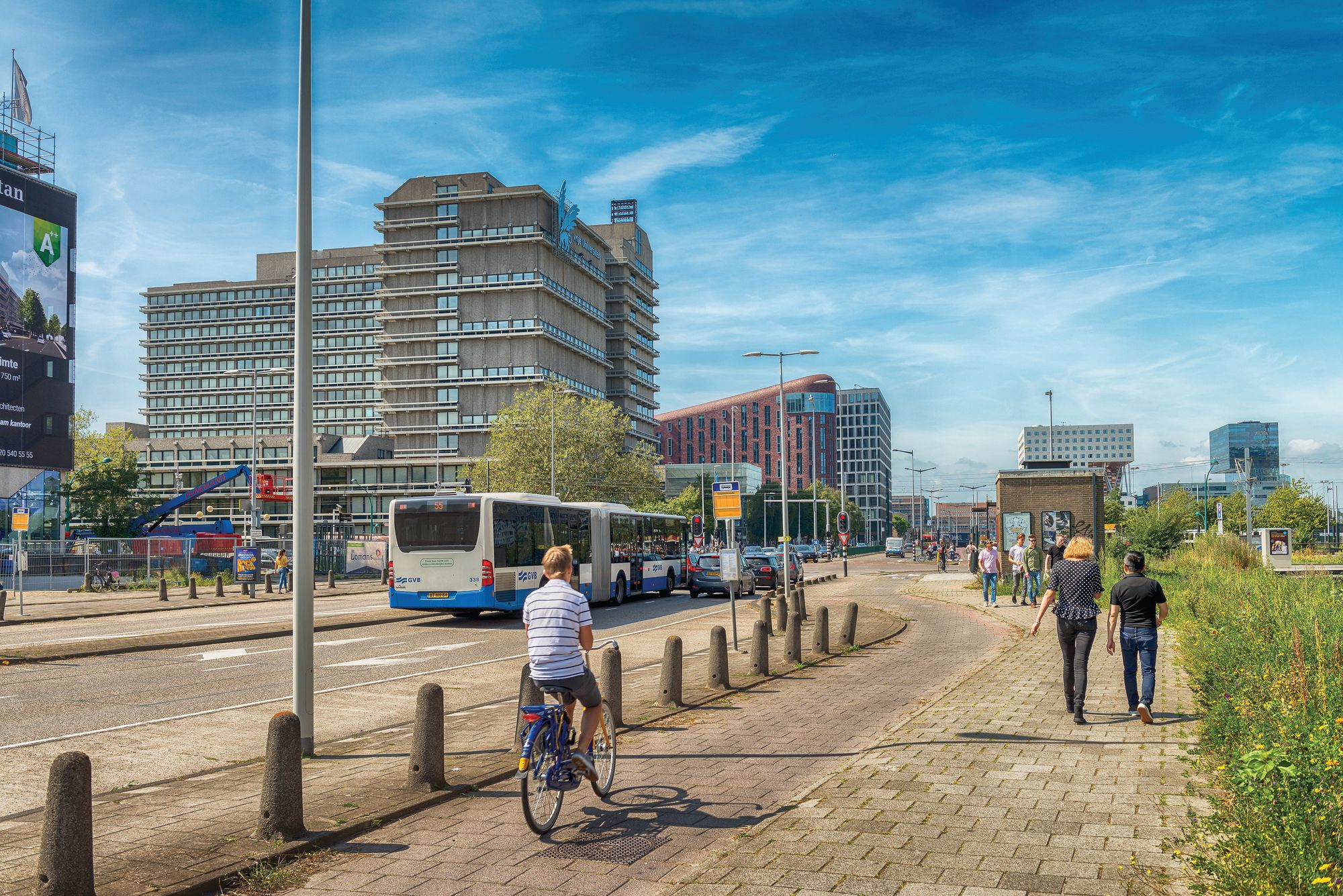
New West Health & Innovation District (HID)
Focus: Transfusion medicine, immunology, haematology and oncology
The Health & Innovation District (HID) is located in the West of Amsterdam in an area that is called “Nieuw West”. HID has a surface of 1 sq km and caters to 2,000 professionals in the life sciences sector. The district is home to Medical Centre Slotervaart (MCS), The Netherlands Cancer Institute, known as the Antoni van Leeuwenhoek Hospital, Center for Care Slotervaart, Cordaan Slotervaart nursing home, and Sanquin Blood Supply (the Dutch National Bloodbank).The campus is also home to Sanagen, Frame Cancer Therapeutics, Prothya Biosolutions, International Plasma and Fractionation Association IPFA, BISC Global, Mitsui Chemicals, and others, such as start-ups and scale ups. The residents complement each other in their shared mission: a better life for patients worldwide. The aim is to create a community where researchers, students, industry, governments, and knowledge institutions can meet, inspire, exchange knowledge, and collaborate in the development of new initiatives. There is access to state-of-the-art laboratories and facilities, such as diagnostics labs, stem cell labs, and a plasma medicines factory. The ambition of HID is to enhance collaboration but also to grow from the 60,000 sq m gross floor area today, to twice that in 2035.Within the District, training is provided by the Sanquin Academy. The Academy promotes lifelong learning as a prerequisite for development, innovation and growth. The Academy can contribute to talent development: by offering a training programme that emphasizes the development of the unique talents of (new) district residents.