
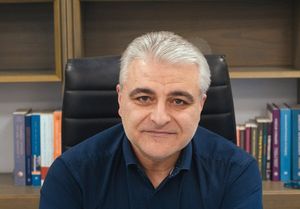
We spoke recently to Nektarios Tavernarakis, Professor of Molecular Systems Biology at the Medical School of the University of Crete.
Tell us a bit about yourself. What is your background?
I am originally from Crete, Greece. I did my undergraduate studies at the Aristotle University, in Thessaloniki, and I earned my PhD from the Department of Biology of the University of Crete, in Heraklion. Later, I did my postdoc at the Department of Molecular Biology & Biochemistry of Rutgers University in New Jersey, USA. I came back to Crete in 2001 and founded the Laboratory of Neurogenetics and Ageing at the Institute of Molecular Biology and Biotechnology (IMBB). Currently, I am Professor of Molecular Systems Biology at the Medical School of the University of Crete, in Heraklion. I am also the Chairman of the Board of Directors at the Foundation for Research and Technology-Hellas (FORTH), the most prominent Research Institution of Greece, which includes research Institutes in Crete, Patras, Athens, and Ioannina. Finally, I am the Chairman of the Governing Board and Executive Committee of the European Institute of Innovation and Technology (EIT).
You said you established your lab in Crete in the early noughties. What is your mission and area of study?
Our research focuses on two major areas of study and research. The first one is neurodegeneration and loss of neurons. The most common neurodegenerative diseases are Alzheimer’s, Parkinson’s and Amyotrophic Lateral Sclerosis. Basically, we aim to expand the understanding of the molecular mechanisms of necrotic cell death and neurodegeneration, and the relationship between cellular metabolism and ageing. The second area of study relates to understanding the ageing mechanisms in animals and how this knowledge relates to humans. A motivation driving this effort is that by being able to manipulate the mechanisms of ageing, we could dissociate the ageing process from age-associated diseases.

Among all the scientific innovations that have come out of the University of Crete, is there one of which you are particularly proud?
Within over 20 years of research in our lab, we have uncovered key mechanisms related to both neurodegeneration and ageing. Several of these studies are published in top-tier, cross-discipline, international scientific journals, such as Nature. I can provide some specific examples. In a study that was prompted by the climate change and the heatwave that swept Europe in 2003, resulting in more than 70,000 deaths, we started looking into the molecular and cellular mechanisms underlying heat stroke. Our aim was to understand how neurons died under heatstroke conditions. As a result, we developed innovative experimental heat stroke models, and identified a novel defence mechanism that functions in cells against necrosis.
Another representative example is a study that we undertook on mitochondria and their relation to the ageing process. The aim here was to elucidate how the function of mitochondria regulates the ageing process in cells and organisms.
In terms of driving innovation, how important is cross-discipline cooperation in your view?
I would argue that interdisciplinarity is vital for modern biomedical research. At our lab, we have worked closely with physicists to develop special microscopes and laser tools to monitor cellular processes in vivo. We have also been interacting with computer scientists and mathematicians to develop models of molecular pathways. I believe that, essentially, biology has itself become a multidisciplinary science.
My next two questions are more from a real estate perspective. How do you think the built environment can encourage innovation among scientists?
Biomedical laboratories are more than just physical spaces - highly sophisticated facilities and infrastructure are necessary. For example, strict specifications are in effect, depending on the level of lab biosafety. In turn, the biosafety level is dictated by factors such as the pathogenicity of the organisms under study, infection hazards, and the nature of the work undertaken in the lab, among others. The optimal route to take is to build labs designed to accommodate biosafety requirements, while accounting for other factors, such as specialised research equipment, and tightly controlled environmental conditions, such as moisture, temperature, lighting, etc. In the end, a laboratory should provide an optimal working environment, where scientists can be productive.
If you had unlimited money but limited space (no more than 1,000 sq m), what would you build?
I would build a meeting space. Science thrives on open communication, discussions and exchange of ideas between scientists. Creating an environment within the institution where researchers can meet during the day and talk about science, would catalyse scientific discovery, and facilitate everybody's efforts. This is particularly important for young researchers, who are starting their career and becoming part of the scientific community. Interaction at this stage is vital for integration. Therefore, a dedicated and functional space that enables close and informal interaction would be invaluable for any university or research institution.
My last question is about Greece and its role in leading life sciences in Europe. What is your take on this subject?
Greece has a large and vibrant biomedical research community spread across the main Greek cities. Researchers in Greece are highly productive and most of them also have extensive international experience. The main problem is not human capital though. What we need to grow is more support and funding from the public sector and also from private initiatives to improve capacity and infrastructure. I am confident that with the right policy mix and proper support, Greece has the potential to excel in biomedical research, and become even more competitive among other European countries.