
Occupier insights

Solving the practical challenges of converting offices into labs

Design strategies to turn awkward office space into labs.
Solving the practical challenges of converting offices into labs
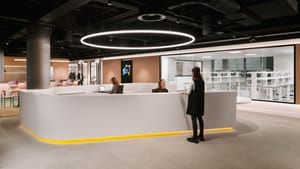
Gensler converts 20 Triton Street in London into flexible, Crick-backed lab space for London’s science district (source: gensler.com)
Table of Contents
In: Occupier insights

The rapid expansion of the life science industry and the growing demand for laboratory space—combined with post-Covid shifts in office use—has triggered a new wave of adaptive reuse: office-to-lab conversions. Transforming underused office stock into in-demand laboratory space is a logical and sustainable solution for landlords, but it brings its own set of challenges. Most buildings suitable for conversion are older and were never designed with scientific work in mind, adding another layer of complexity.

Working with the building you inherit

The core challenge in any conversion is working intelligently with the existing structure. Laboratory designers must craft spaces that support scientific work while respecting—and often contending with—the building’s constraints. In this article, I’ll outline some of the most common issues I’ve encountered and how awkward, inherited spaces can be reshaped into functional research environments.

Written by
Emily Urban
Emily Urban is a Dubai-based life science real estate and design specialist. With a scientific background, she creates functional, future-ready R&D and lab spaces, bridging science, design and real estate to support effective research environments.
More from Life Sciences Real Estate

Stay on top of the life sciences real estate markets in Europe

Join us
Great! You’ve successfully signed up.
Welcome back! You've successfully signed in.
You've successfully subscribed to Life Sciences Real Estate.
Your link has expired.
Success! Check your email for magic link to sign-in.
Success! Your billing info has been updated.
Your billing was not updated.