
Insights from Natalie Kenny on the attractions of northern England for life sciences companies and their staff.
Introducing Knowledge Quarter Liverpool (KQ Liverpool)

Commercial space
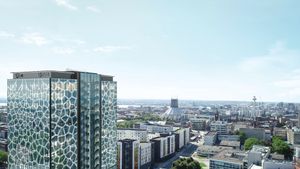
The Spine: officially opened in May 2021 at a cost of £35 million (€40.2 million), The Spine is the first Grade A office building to be developed in Liverpool City Region for over a decade. The 160,000 sq ft (14,866 sq m) 14-storey building is located at the eastern gateway to the Knowledge Quarter in the emerging Paddington Central location. It is BREEAM Excellent rated, has a tiered event space, and an internal sky garden. The building’s lower and upper floors are occupied by the Royal College of Physicians, with other occupiers including Clatterbridge Cancer Centre, LYVA Labs and the northern headquarters of Cashplus Bank. Accelerator: is a £25 million (€28.7 million) partnership between Royal Liverpool and Broadgreen University Hospitals Trust (RLBUHT) and Liverpool School of Tropical Medicine (LTSM). The building is c. 30,000 sq ft (2,787 sq m), comprising Category 3 labs, insectaries, offices, collaboration zones, meeting rooms, and a health café. It is central to Liverpool’s ambition to develop a city centre health care campus and has been designed to stimulate the flow and exchange of ideas. Occupiers include Needle Smart, iiCON, and Excalibur Healthcare Services.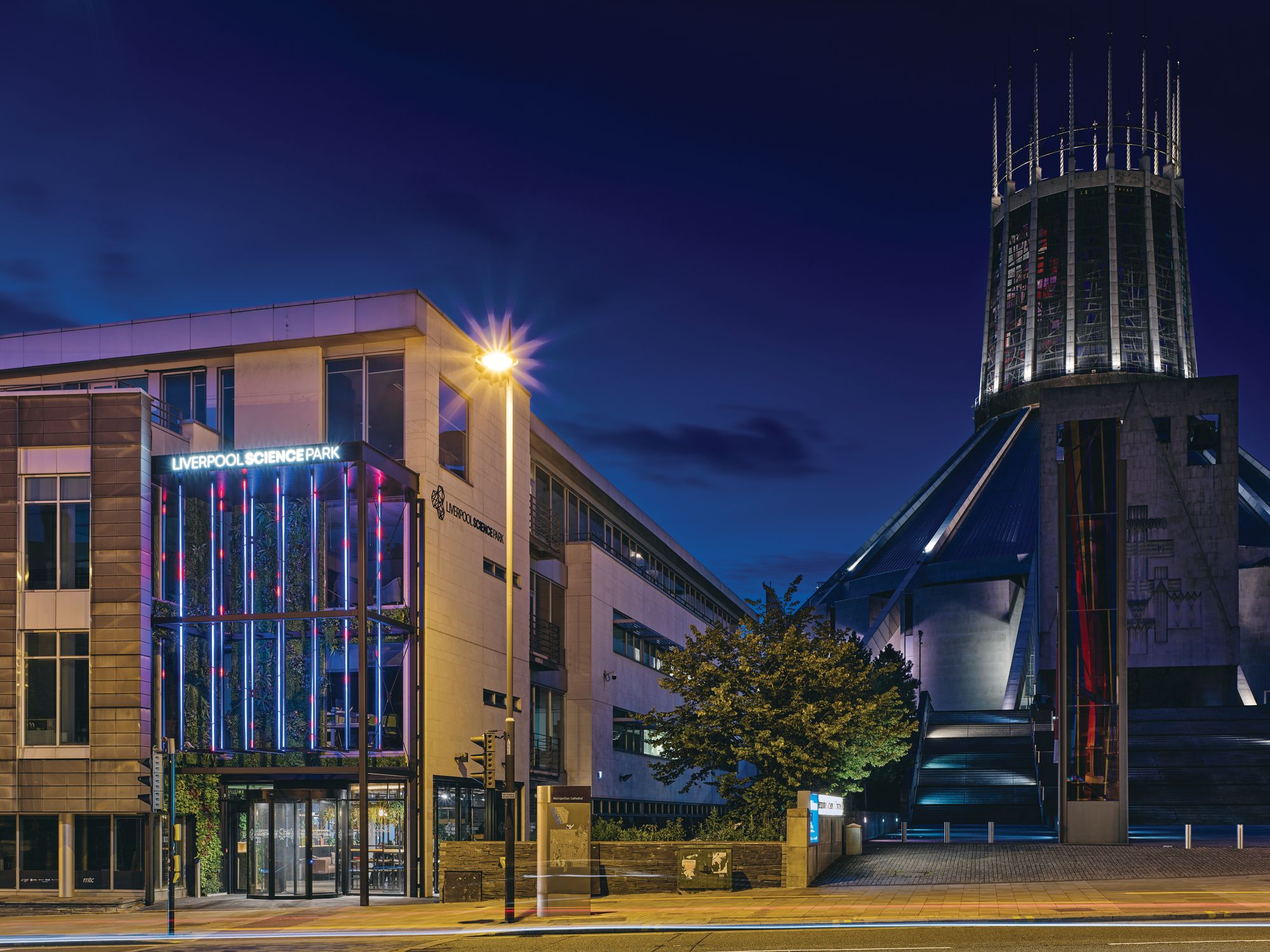
Liverpool Science Park
Comprises two buildings, Innovation Centres 1 and 2,offering 120,0000 sq ft (11,149 sq m) of Grade-A office and laboratory accommodation. The Park is operated by Sciontec, the commercial spin-out property development company of KQ Liverpool in which Bruntwood SciTech took a 25 per cent stake in 2020. It has a diverse range of over 60 tenants including Biomimetica, Centre for Process Innovation (CPI), Gemini Biosciences, Tandem Nano, and Videregen. Flexible office and lab space is available from £16.50 per sqft pa (€17 psm/mth).
Materials Innovation Factory (MIF)
(MIF): The £68 million (€78 million) MIF is a partnership between Unilever and the University of Liverpool, combining one of the country’s largest research-active companies with one of the strongest chemistry departments in the UK. The facility allows businesses from start-ups to mature entities to
access world class automated lab equipment and technical support to rapidly scale-up capacity. Long-term Research Hotel residencies are available for up to seven people, offering the ability to co-locate industry research teams on site with MIF specialists.
Digital Innovation Facility (DIF)
The University of Liverpool and Liverpool City Region Combined Authority Local Growth Fund provided the £12.7 million (€14.6 million) for a 16,150 sq ft (1,500 sq m) three-storey specialist facility to accommodate the UK’s leading centre for the development and industrial application of next-
generation digital technologies, bringing together experts from engineering, computer science and chemistry. The facility provides a range of specialist labs for AI and robotics advancement.
Sensor City
It is the focal point for sensor technology innovation and development in the UK. It is purpose-built city centre hub of 27,000 sq ft (2,509 sq m) over four floors. It is a collaboration between the University of Liverpool and Liverpool John Moores University and is a flagship University Enterprise Zone. The building houses 21 flexible working suites ranging from 140 sq ft (13 sq m) to 829 sq ft (77 sq m) which can be sub-divided according to tenant requirements. There are shared meeting rooms, workshops, and breakout areas, and a dedicated conference space that will accommodate 80 people. Sensor City is home to some of the most sophisticated labs for sensor and Internet of Things (IoT) technology development in the UK.Further development
There are a number of further areas under development within KQ Liverpool that will contribute to creating the broad mix of science, tech, retail, leisure, and residential-led mixed use facilities that will contribute towards building critical mass and a vibrant and collaborative urban cluster on a scale not seen outside of London. Paddington Village: is a £1 billion (€1.14 billion), 30-acre (12.1 ha) urban village, flagship development site owned by Liverpool City Council. Science,tech, education, and health are central to its DNA. Development started in 2017 and will comprise three phases. The first phase of Paddington Central is well underway, with several projects already complete, including the aforementioned “The Spine” Grade-A offices, the University of Liverpool International College, a 1,250 multi-storey car park, and a 221-room Novotel hotel, which opened in the summer of 2022. This is a long-term project, with the third phase not expected to complete until the early / mid- 2030s. In November 2022, Sciontec Developments obtained planning consent for a 120,000 sq ft (11,149 sq m) 8-storey flexible, innovative workspace development called Hemisphere. It will be the first operational net zero carbon innovative workspace building in the Liverpool City Region. Construction is due to start in 2023, with completion expected in 2025. Hemisphere will sit adjacent to The Spine in Paddington Village. A demand study has been commissioned to better gauge the type of space and flexibility required, but discussions are already underway with a range of tenants from the health, science, technology, digital, and education sectors.Fabric District
A collection of stakeholders and business and property owners are driving forward major regeneration and rebranding to create a collaborative and vibrant area of the city which caters to the professional clientele of the Knowledge Quarter as well as the tourists passing through the area.