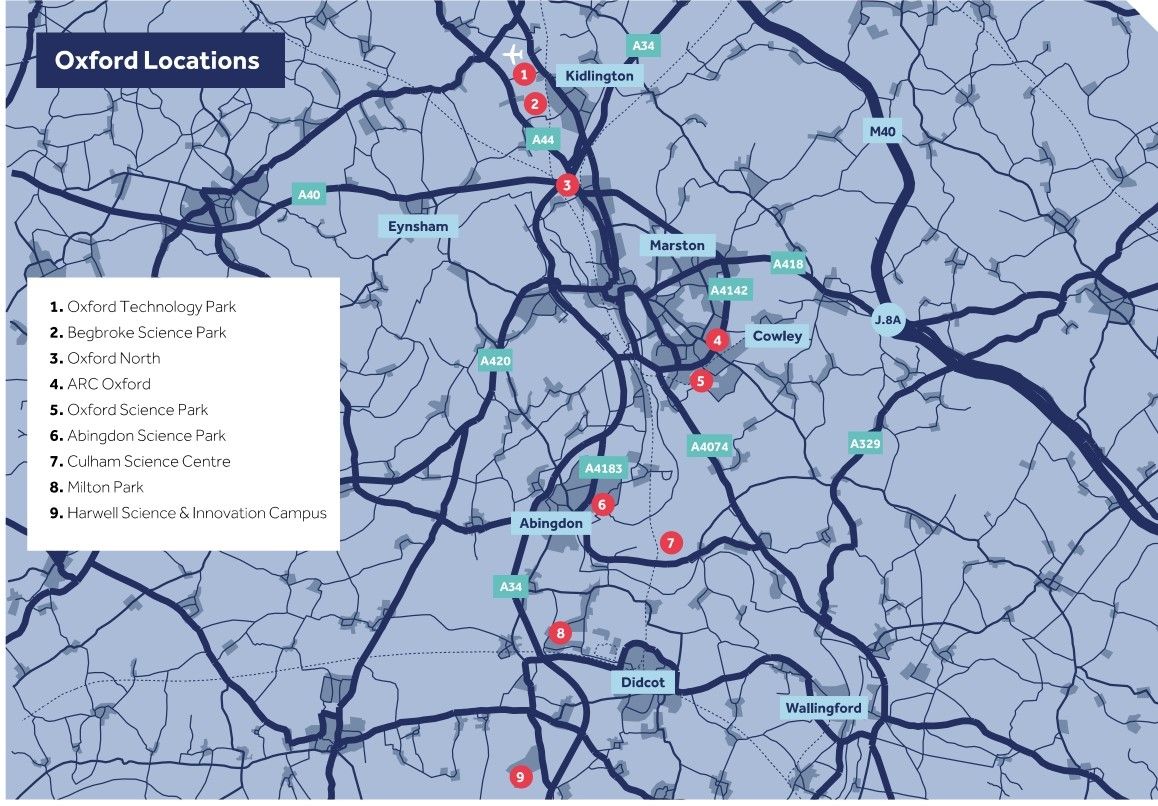

Oxford lab, technology, and innovation locations
The Oxford cluster covers a broad geography from Kidlington (7.5 miles / 12km) to the north of Oxford to Harwell (14 miles / 22.5km), Wantage (16 miles / 25.5km), and Wallingford (13 miles / 21km) to the south. In this section we will focus on nine of the key locations.1/ Oxford Technology Park
Located close to Kidlington and eight miles (13 km) north of the city, the Park comprises over 20 acres (8 ha) with 11 commercial buildings (200,000 sq ft / 18,580 sq m) offering a range of lab, production and office space. Bought buy Life Science REIT in May 2022 for £120.3 million (€136.8 million), the transaction also included a forward funding element of £62.7 million (€71.3 million) to complete the Park’s build-out to a total of 450,000 sq ft (41,810 sq m). Completion is expected in late 2023 or early 2024. Planning consent was obtained in January 2023 for phase 4 of the development, to include three new buildings. The new hybrid tech box accommodation is designed to be as flexible as possible, providing 14 ft (4.2 m) slab to slab (ceiling height) units over two floors with a steel frame and concrete floors. The units are equipped with appropriate M&E and power upgrades, big risers, and loading bays can be installed if required by the tenant. These units can be 100 per cent offices, 100 percent production, 100 per cent wet labs or anything in between. Requirements from 6,000 sq ft (557 sq m) to 50,000 sq ft (4,645 sq m) can be accommodated. Tenants include Oxford University spin-out Oxford Ionics Limited and Native Antigen.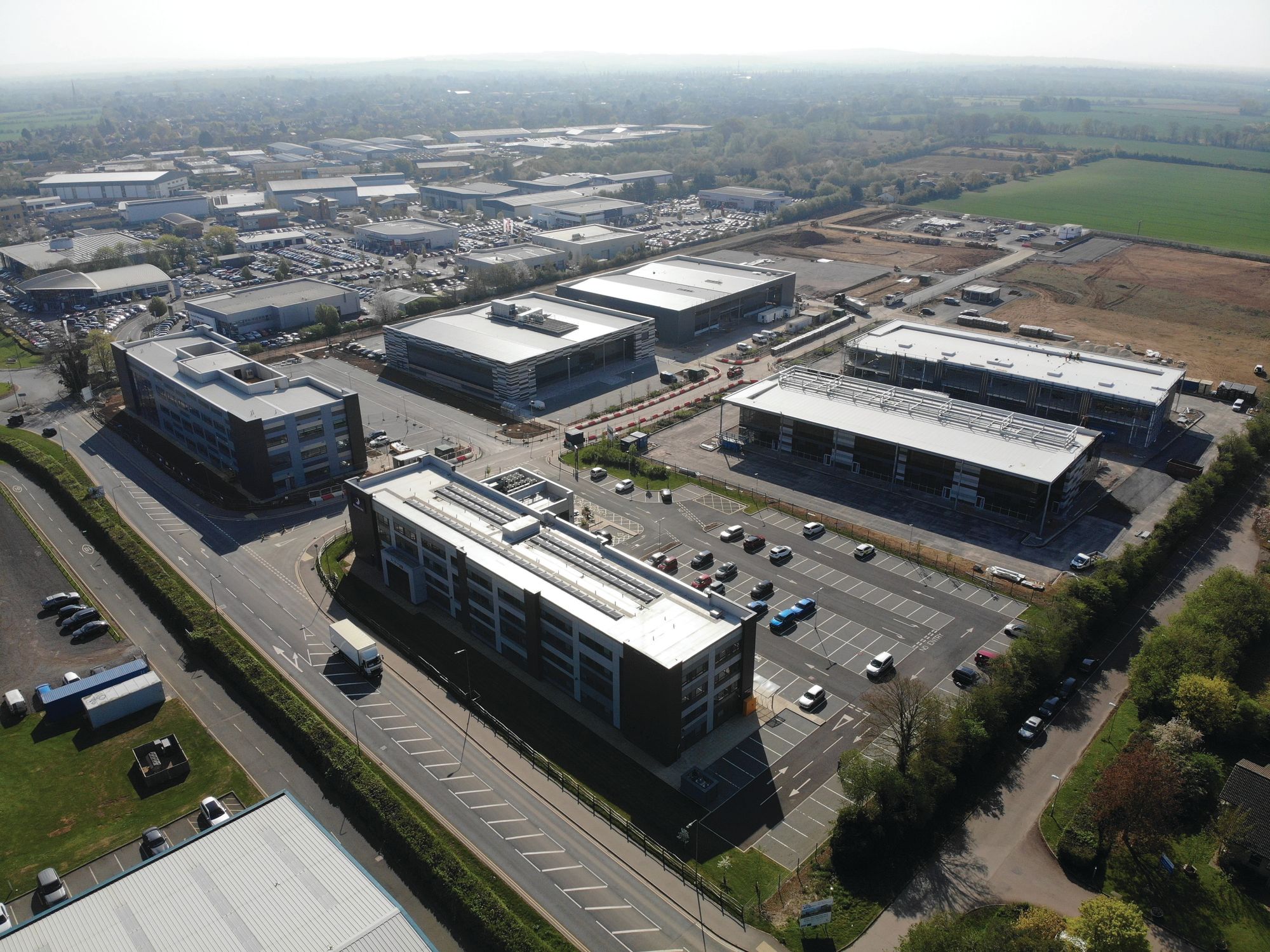
2/ Oxford University Science Park, Begbroke
Lying west of Kidlington and seven miles (11 km) north of the city, Begbroke is unique in that it is the only science park owned and managed by Oxford University. The three main buildings are the Centre for Innovation and Enterprise (CIE), the Hirsch Building, and the Institute of Advanced Technology, each offering c.30,000 - 35,000 sq ft (2,730 – 3,290 sq m) of usable space. The University is working with Oxford University Development (OUD), a joint venture with Legal & General, to develop a 35 acre (14 ha) adjacent site which will provide two new buildings by Q1 2024. One of these is to be a university academic research building of approximately 54,000 sq ft (5,000 sq m gross area) hosting a mixture of academic users and shared facilities. There will also be a commercial R&D building of nearly 80,700 sq ft (7,500 sq m gross area) leased to a major occupier. Tenants include Adaptix, Cortex Organics, and Energenics Europe Limited.3/ Oxford North
It is a major new innovation district under construction four miles (6.5 km) north of the city centre, close to the A34 and A40 arterial routes. The £700m (€796m) development is being brought forward by Stanhope, Cadillac Fairview and Thomas White Oxford Limited (wholly owned by St John’s College, Oxford). Outline planning consent has been granted for the 64-acre (26 ha) masterplan. In addition to the 4,500 new jobs being created across an estimated 936,500 sq ft (87,000 sq m) of lab and workspace, the project will incorporate 480 new dwellings, of which the first 317 new homes are under construction by Hill Group, and three new public parks, amenities, a hotel, and a nursery.4/ ARC Oxford
The former Oxford Business Park was bought by Brookfield from TPG Real Estate Partners in June 2021 and rebranded as ARC Oxford (Advanced Research Clusters) in September 2022. It formed part of the Arlington business that was purchased for £714m (€812m) and included several other assets including Hammersmith Embankment and Uxbridge Business Park. The site is located on the Oxford ring road just under three miles (4.8 km) southeast of the city. The 88-acre (37 ha) campus comprises c.1m sq ft (92,910 sq m) of commercial space. About 200,000 sq ft (18,100 sq m) was reported to be available for repositioning as of the end of 2021. The campus hosts over 35 science and innovation businesses and 3,500 employees with supporting infrastructure. Brookfield is planning a “generational investment in the campus with a vision to create a 21st Century Science and Innovation community”. Media reports plans to increase space by 75 per cent (750,000 sq ft / 69,690 sq m). The results of the public consultation held in October 2022 regarding Plot 2000, which encompasses a maximum of 14 storeys and 398,230 sq ft (37,000 sq m) gross external area including parking, are awaited. Tenants include Accession Therapeutics, Jazz Pharmaceuticals, Oxford BioMedica, Oxford Biodynamics, and Cancer Research UK.5/ The Oxford Science Park (TOSP)
It was established in 1991, TOSP is one of Europe’s leading science parks and is predominantly owned by Magdalen College Oxford in a strategic partnership with an affiliate of Singaporean sovereign wealth fund GIC. The Sherard Building, offering 28,000 sq ft (2,600 sq m) of offices and labs, was bought by Kadans in May 2021. The Park provides almost 750,000 sq ft (69,680 sq m) of office and lab workspace and is located four miles (6.5 km) southeast of the city. It is home to about 2,700 employees and over 100 companies. In January 2023, TOSP acquired the Hinshelwood Building (31,580 sq ft / 2,935 sq m) from Mayfair Capital Investment Management Limited. The Park’s ongoing investment programme includes six new buildings occupying over 600,000 sq ft (55,742 sq m) and offering new state-of the-art facilities. The Iversen Building, a 110,500 sq ft (10,270 sq m) GIA CL2 ready lab and office building due to complete in the summer of 2023; the Leggett Building (81,400 sq ft / 7,560 sq m) planned for the summer of 2025; three office and lab buildings totalling 400,000 sq ft (37,164 sq m) granted consent in March 2023 on plots 23-26, and a 75,000 sq ft (6,970 sq m) unit to complete in 2025 on Plot 27. A new station on the Cowley branch line is also proposed. Tenants on TOSP include Exscientia, OMass Therapeutics, Oxford Nanopore Technologies, Evox Therapeutics, and Oxford Science Innovation.6/ Abingdon Science Park
It is seven miles (11 km) south of the city centre. Kadans Science Partner acquired The Science Quadrant from Addington Capital in January 2021 for an estimated £13 million (€14.8 million). The transaction included 1.59 acres (0.64 ha) of land with planning consent for a further 20,000 sq ft (1,858 sq m) of offices and lab space. The scheme comprises four terraces of office and laboratory buildings totalling 75,300 sq ft (7,000 sq m). Kadans also acquired Monarch House and Penlon House (totalling c.50,000 sq ft / 4,645 sq m) in August 2021. Barton House will be a new purpose-built laboratory/ office space of 26,500 sq ft (2,460 sq m) offering fully fitted laboratories or Cat A labs and offices. Delivery is expected in Q3 2023. In February 2023, Kadans acquired Grange Court (to be rebranded as Sovereign House) and will reposition the asset to provide c.20,000 sq ft (1,858 sq m) of high-quality office and lab accommodation for occupation in Q3 2023. Tenants include Bio-Techne, Continuum Life Sciences, Sense, PsiOxus Therapeutics, and Gene First.7/ Culham Science Centre
It is located nine miles (14.5 km) south of the city on a 198-acre (80 ha) site and forms part of the science, technology and innovation cluster known as Science Vale Oxford. It is owned and managed by the UK Atomic Energy Authority (UKAEA) and is home to the Culham Centre for Fusion Energy (CCFE). In 2016 Culham branched out into two new areas accommodated in two new buildings: the Materials Research Facility (MRF) and Remote Applications in Challenging Environments (RACE), which builds on expertise in remote handling from operating the Joint European Torus (JET) – the focal point of the European fusion research programme and the world’s largest fusion research machine. Culham hosts a diverse community of over 40 public and private sector organisations employing c.2,000 staff. The centre has plans to grow by 50 per cent and part of this will be facilitated by a planned 86,000 sq ft (7,990 sq m) R&D building comprising engineering and office space. Legal & General agreed a 35-year income strip forward-funding agreement in June 2022. In addition to tenants involved in fusion related research, occupiers include Reaction Engines Limited, Aurox Limited, GeneFirst, GoSat, National Nuclear Laboratory, NeuroBio, and Sigma Lithium. Oxford Innovation Limited manages incubator space for spinouts and start-ups.8/ Milton Park
It lies 12 miles (19 km) southwest of Oxford. The Park has been owned and managed by MEPC since 1985 and during that time the size of Milton Park has tripled. (MEPC is a property investment and development business owned by the British Telecom Pension Fund and the Royal Mail Pension Fund). While it accommodates a diverse range of commercial occupiers, it has also become one of the largest science and technology clusters in Europe. The Park hosts 350 organisations employing 15,000 people across 4 million sq ft (371,640 sq m) of commercial space. Looking to the future, Milton Park launched its 2040 Vision Master Plan in 2019. This sets out an incremental provision of flexible and adaptable office/lab and industrial/lab space over the next 20+ years. It has the potential to add 10,000 jobs alongside the addition of new neighbourhoods and communities. Life Sciences tenants at Milton Park include Adaptimmune Limited, Biocleave, Corteva Agriscience, Emergex Vaccines, M:M bio, and Oxford Bio Therapeutics. Technology businesses on the campus include 30 Technology, Cheetah Digital, Gardin Limited, Halliburton Landmark and Purely Air Tech Limited.9/ Harwell Science & Innovation Campus
It is located 16 miles (26 km) south of Oxford and just over five miles (8km) southwest of Didcot, off the A34. Harwell claims to be the leading science and innovation campus in the UK. Over 2,000 academic papers were published in peer reviewed journals in 2019-2020, the site hosts 14 national facilities, £3 billion (€3.4 billion) of scientific infrastructure and homes over 200 organisations and more than 6,000 scientists, engineers and innovators. In April 2020, Brookfield Asset Management, acquired a 50 per cent stake in Harwell Campus from U+I Group PLC and Harwell Oxford Partners Limited for c. £220 million (€249 million). What makes Harwell unique is its history and large-scale infrastructure. Developed as an RAF base in 1937, it was taken over by the Atomic Energy Research Establishment in 1946 to become the Harwell Laboratory and the site of Europe’s first nuclear reactor. Significant major facilities onsite containing some of the most powerful scientific equipment in the world include the Central Laser Facility (CLF), Diamond Light Source (synchrotron), the Extreme Photonics Applications Centre (EPAC), the European Space Agency’s satellite and telecommunications centre (ECSAT), the National Quantum Computing Centre (NQCC), and the Research Complex at Harwell (RCaH). Harwell’s onsite cluster communities are key tocollaboration and connectivity. Dedicated clusters include: Space, Energy Tech, Health Tech and Quantum, each with the potential to be multi-disciplinary. In addition to the major infrastructure and science facilities listed above, tenants include the UK Health Security Agency, RAL Space, Satellite Applications Catapult, Oxford Nanopore Technologies, Thales, Siemens, and The Faraday Institution. In July 2021 it was announced that the Natural History Museum will move into a new 320,000 sq ft (19,730 sq m) science and digitisation facility at Harwell. The museum will transfer about one third of its collection (c. 27 million specimens) over a period of five years. In March 2023, it was announced that Moderna, a biotechnology company pioneering messenger RNA (mRNA) therapeutics and vaccines, has selected Harwell as the location for its Moderna Innovation and Technology Centre (MITC). The MITC development will encompass a research, development and manufacturing facility in two buildings of 145,000 sq ft (13,462 sq m). Construction will start this year, with completion due in 2025.Other major projects of note in Oxford
Proposals for a UK branch of the Ellison Institute for Transformative Medicine (EITM) were submitted to the local council in December 2022. The proposed development includes Plot 18 of The Oxford Science Park and features a complex of buildings spread across two sites. The facilities consist of two R&D buildings, a clinic, and educational spaces, including an auditorium. Additionally, extensive gardens will connect the buildings, with an 820 ft / 250m-long elevated timber walkway serving as a link between the sites. Standout elements include a spherical library known as the “Collaboration Theatre”which will be topped by a double-layered timber geodesic dome that rotates over the course of the day to provide shading. A second geodesic dome known as “The Nest” will be built as an informal meeting space. The University of Oxford and Legal & General, through their Oxford University Developments (OUD) partnership, is developing the £200 million (€228 million) 269,100 sq ft (2,896 sq m) Life and Mind Building on South Parks Road between the listed University Parks, the Science Area and the historic city centre. It will provide research facilities for 800 students and 1,200 researchers and house the Departments of Experimental Psychology and Biology, including Plant Sciences and Zoology.