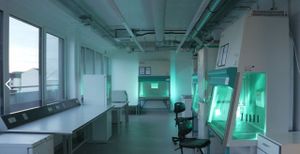

The life sciences sector is growing and so is the demand for suitable R&D premises, presenting public sector bodies and commercial developers with an opportunity to repurpose existing assets into laboratory facilities. “It is fast, cost-effective and sustainable", says AECOM’s Alison Wring, Director Commercial Science / Tech Lead.

The UK’s life sciences sector is a national success story. Figures from the Office for Life Sciences (2020) show that the sector supports almost 270,000 jobs and generates €105.5 billion (£88.9 billion) in economic value. It continues to grow fast. This growth is, in part, thanks to historic and continued investment. In the Autumn 2021 budget, the Chancellor of the Exchequer (the government’s chief financial minister), Rishi Sunak, committed to spend €5.9 billion (£5 billion) on health-related R&D before 2025. Further, in March 2022 the Department for Business Energy & Industrial Strategy (BEIS) and the Department of Health and Social Care (DHSC) announced up to €237.4 million (£200 million) to support NHS-led health research into diagnostics and treatment and €71.2 million (£60 million) of new government funding to expand life sciences manufacturing in the UK.
The sector is also in the spotlight as numerous organisations, from global pharmaceutical companies to the DHSC, Public Health England (PHE), academia and science parks collaborate on further Covid-vaccine development and new drug innovation. This combination of factors means that the demand for suitable, well-located research and development facilities is rising very fast, creating an acute shortfall of space in key locations.
Whereas building new premises is slow and carbon intensive, refurbishing existing office space offers a faster and more efficient solution. It is a golden opportunity for commercial developers and public sector bodies to reevaluate their existing assets to meet that demand - one that has the potential to deliver higher rental returns. In this article we examine life science sector needs, and why it is a suitable time to repurpose surplus sites. We also share five key factors for asset owners when considering repurposing spaces into lab environments.Understanding sector needs
So, what exactly is the life sciences sector looking for? For most the answer is location, location, location. As traditional science disciplines blend with tech and digital science, life science companies are increasingly seeking out premises in areas where Innovation Districts are either established or emerging.
According to laboratory fit-out specialists Galileo Labs, “The nature of life science research is shifting to a collaborative model where co-location and open and accessible facilities for smaller science companies is required. Combining the academics with clinical staff as well as R&D partners creates a unique ecosystem, making property in the area extremely sought after.”
With continued investment in rail infrastructure, Cambridge and London connectivity is supporting the growth of these life science/ healthcare ecosystems, alongside Oxford. Activity in the capital is centered round the Knowledge Quarter at King’s Cross/Euston as well as Imperial College’s Innovation District at White City. Other key areas in the UK include Alderley Park near Manchester, Innovation Birmingham near Aston University, and Edinburgh’s BioQuarter. Across the water, Belfast and Dublin both have thriving Life Sciences clusters, particularly with the convergence of technology and life sciences.
The UK is still adjusting to new remote working practices related to coronavirus, but the sector is very limited in terms of what can be done outside the laboratory environment due to the need for sterile spaces and the increasing use of artificial intelligence to process vast data sets at speed. Demand is therefore growing for a range of accommodation from small labs for start-ups to larger combined laboratory and office space for more mature businesses.
Crucially, life science companies are also moving more towards enhanced office environments having smaller areas of wet/dry lab content, as traditional analysis methods are being replaced by smart, advanced technology. This is good news for those looking to repurpose existing facilities because less floor space needs the structural and services modifications to accommodate wet/dry lab areas. However, no matter what the size or type of accommodation, colocation remains a key draw.
Repurposing existing space to meet demands
The UK has significant unmet property demand for small and large purpose-built science space in key locations. Public sector organisations looking to relocate or improve well-located parts of their estates (while at the same time disposing of more obsolete sites) are in a strong position, particularly if they consider working with commercial partners.
Repurposing an existing office block (or other space) with the right design parameters for laboratory use is advantageous in many ways. . In London’s King’s Cross, the representative rental values for laboratory space start at €96 per sq m per month (£90 per sq ft per annum) and can exceed €133 per sq m per month (£125 per sq ft per annum) depending upon facilities and fit-out. Prime office rents in King’s Cross are in the range €75 to €80 per sq m per month (£70 to £75 per sq ft per annum). This indicates a premium of c.30 per cent or higher for quality lab space in the area.
From a sustainability perspective, the refurbishment can deliver a 56 per cent reduction in carbon emissions compared to a new build facility, giving lab space strong eco-credentials that may be attractive to prospective tenants. Aside from sustainability, there are significant gains in terms of speed to market. In addition, refurbished space can be flexible enough to accommodate multitenant start-ups right up to more established operators, who may wish to rent entire floors.
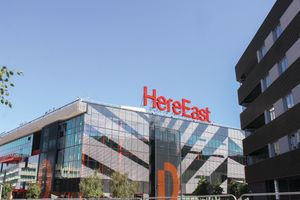
A Conversion in East London
Here East, formerly the Media Centre for the 2012 Olympics, is a good example of a building repurposed as an innovation and technology campus for start-up companies.
Here are five considerations when refitting space to a laboratory environment
Consider slab heights and risers
An initial viability study needs to quickly determine the slab-to-slab height of a building to establish whether there is enough height to bring in additional services, such as risers. Typically, a lab storey height (top of slab to soffit) would be 4.1 to 4.5m (13.8 to 15.2 ft) high, allowing for the vertical distribution of air across the floor plate, compared to an office which is more likely to be 3.6 to 4.2m (12.1 to 14.2 ft). Older properties such as telephone exchanges, banking halls and financial institutions generally lend themselves to this configuration, due to their dense frame and generous storey heights.
Equally warehouses, industrial premises and even shopping malls could be considered. A solution to lower storey height buildings is to create greater density of internal risers and plant room space. Existing basement space can also be used to house plant.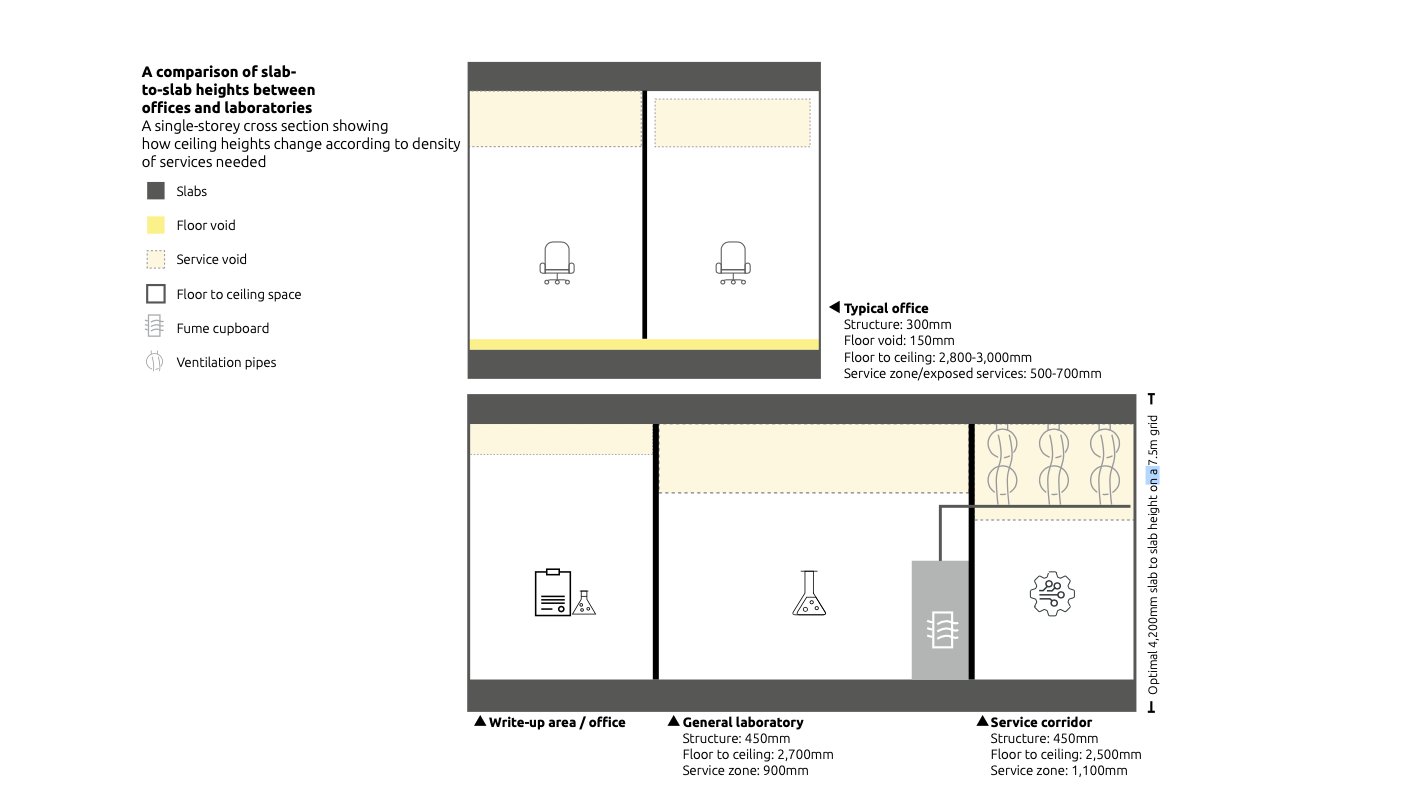
Factor in wellbeing
Facilities with roof terraces and other recreational zones will be highly sought after, especially in urban areas. Scientists work in controlled environments so break out areas such as wellness/ contemplation rooms and outside spaces will be in demand. These spaces can also be safely adapted to serve a variety of functions.
Lifts
The increased cellularization required to convert an open-plan Category A office into multiple start-up/incubator type labs means additional lift cores may be required, depending on the size of the floorplate and the targeted number of tenants. Buildings with multiple existing lift cores may be able to provide access to multiple tenancies without such modifications. . Having multiple lifts allows each tenant to have a separate access and a place to apply their entrance branding, giving them a clear presence. There may also be a need to provide a dedicated goods lift.
Services
There must be suitable plant and riser space for lab gases, specialist fume extraction and steam generation. The need for these services differs depending on the type of research being conducted and, therefore, will be unknown until a tenancy agreement is struck. It is common for such systems to be either instructed during construction once a tenant has been found or installed after completion of the main fit-out. Hazardous waste disposal may be needed but will be addressed by the tenant if hazardous chemicals are to be used.
Legal considerations
Planning issues may arise regarding any additional rooftop plant, as well as when increasing the height of the building itself. There may also be heritage issues to consider, as well as the possible removal of asbestos in older properties.
Fit-out options
Level 1: Shell and incoming utilities supplied only; Building in basic form, with incoming utilities only, Core utilities to be capable of supporting expansion. Level 2: Shell is provided, core (landlord) areas fully fitted out, Building landlord areas only fitted out, with incoming utilities provided for expansion.Tenant to fit out with plant and services to tenant demise.Level 3a: All plant and services risers provided for the building. Main plant provided to service entire building to agreed capacity. No requirement for additional tenant plant unless for specific requirement(for additional cooling or air). Space for additional tenant plant provided if required. All services in risers provided and capped off ready for connection into ceiling void. Space(including ceiling void) to be fitted out by tenant.Level 3b: All plant, services risers and ceiling voids provided for the building. As with 3a but fit-out services in the void. Lights, grilles and ceilings could be provided.Level 4: Building fully fitted-out and ready for occupation,Fully fitted out building ready for occupation and use, Space for tenant plant not required.Take advantage of financial incentives
There are specific tax benefits associated with R&D. The capital cost of construction works to create dedicated research facilities for owner-occupiers benefits from 100 per cent capital allowances.
Any innovative design or construction solutions to overcome site-specific scientific or technological uncertainties may qualify for R&D tax credits.
These provide an enhanced (or super) deduction of 230 per cent for eligible staff costs for SMEs, or a 13 per cent ‘above the line credit’ for large companies.
A golden opportunity
The case for refurbishment has never been stronger, and not just because it is a low-carbon alternative to building new premises.
It is also cost-effective and has the benefit of faster speed-to-market delivery, as well as being an opportunity to unlock assets in high-demand locations.
More space is clearly required to enable the life science sector to grow and refurbishing existing assets can help meet the demand for well-located, well-equipped laboratory space, while providing healthy returns.
The design and construction industry still has some way to go in communicating and demystifying the office-to-lab refurbishment process and increasing awareness amongst asset owners that they have a golden opportunity to maximise their under utilized or poorly performing assets. However, the case for office to laboratory refurbishment is strong and, as a result, we expect confidence amongst asset owners to grow.