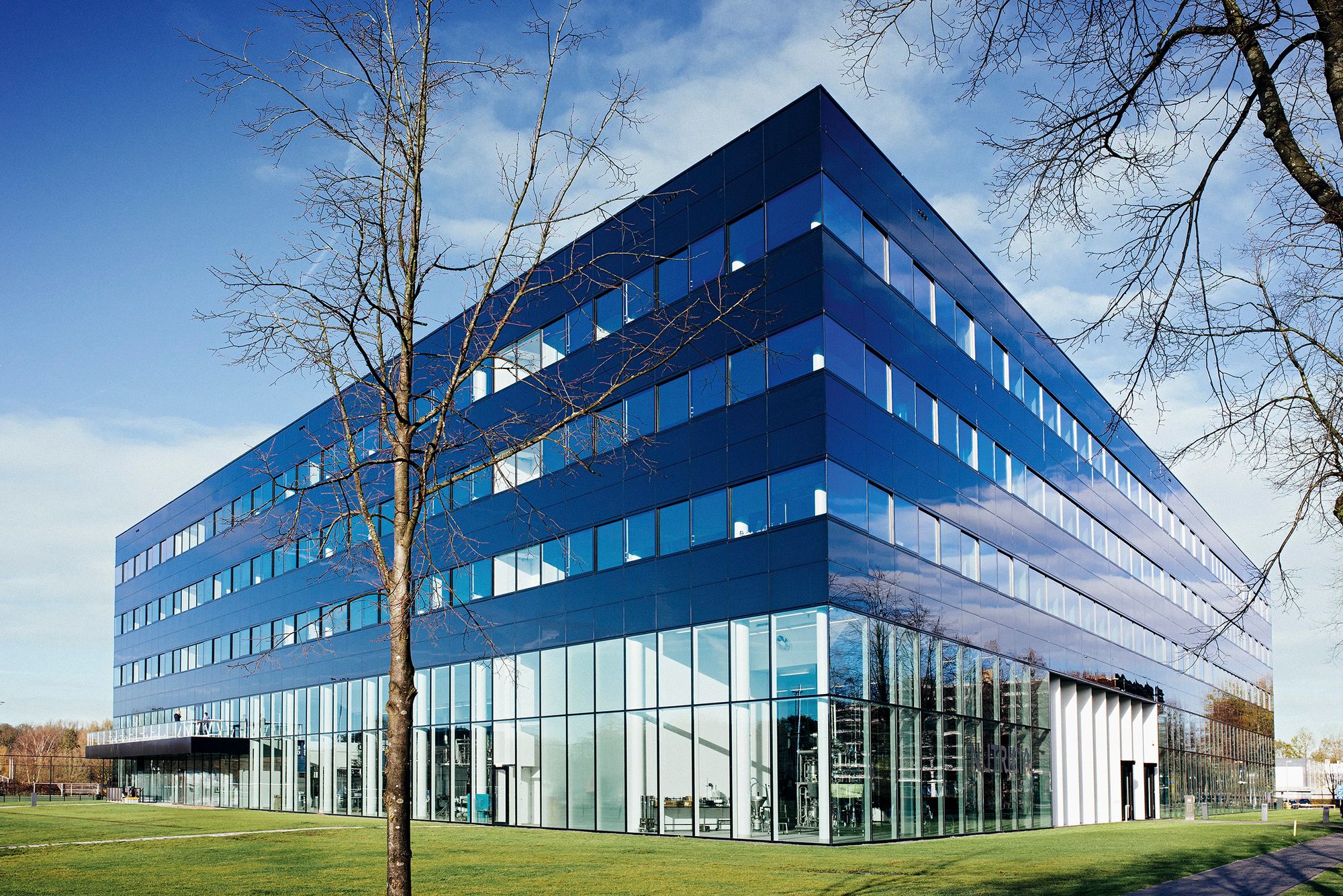
We spoke with George Fraser-Harding, head of European Funds at Aviva Investors, about life sciences real estate. Aviva Investors has been investing for more than ten years in the sector with an investment volume of
approximately £1 billion (€1.14 billion). The majority of the investments is located in the United Kingdom in cities like Cambridge, Oxford and London.
We also invested in Continental Europe, for example in the R&D headquarters of Danone in Utrecht Science Park in the Netherlands.
Danone R&D Headquarters in Utrecht
Why include life sciences assets in a real estate investment portfolio? What is the added value?
In general, we believe that there are two important characteristics to add value in equity real estate. One way to add value is to invest in the major longer-term trends that are driving the economy and the real estate markets. A good example is the logistics sector. Another way to add value is by taking on more operational risk such as in the living sectors. We do see that that real estate has become more operational over the last ten years. Sitting back and taking rent is no longer an option for growth investors. The days of limited capital reinvestment and taking negligible operational risk are over.
The life sciences sector uniquely allows you to focus on both characteristics. Life sciences is an important driver in the economy and there are opportunities to create value by operational management. We
have demonstrated in Greater Cambridge that running a park as a service (with high operational intensity) adds additional value in addition to getting market beta from just investing in the sector.
How important is it to understand clients, tenants (universities, life science businesses), and communities?
It is a key element to understand the micro-environment for a life science project. Our experience is that getting close to occupiers and letting them expand in your park is the best way to drive returns. Up to recently, there was (and still is) a very high proportion of owner occupation. It is mainly a build-to-suit market as the tenants have very specific demands. Therefore, it is very important to understand their needs. Building speculatively is a risk that developers are rarely willing to take for that reason.
The tenant pool in Life Science is specific - we must provide spaces that are meeting our target tenant’s needs and provide a great third-party usability. Besides building factors like a good standard of fit out and the
possibility to build laboratories, potential tenants also have precise location requirements.
What are the advantages and disadvantages of clustering of life sciences on specific parks?
Established science and tech clusters are characterised by a great talent pool, the presence of synergistic organisations, access to capital and a favourable business and tax climate. Often, those clusters emerge in the neighbourhood of renowned universities, research institutes, hospitals, subsidiaries of sector leaders and incubators. All the actors of the clusters can benefit from an ecosystem of companies and investors.
Properties outside those micro-clusters do not have the same level of attractiveness to Science and Tech tenants. However, the clusters are usually outside main cities and located in secondary or third tier locations, where accessibility with public transport could be a little bit more difficult. For example, the Paris science clusters are located for some 45 minutes to 1 hour of travel time from the central business district. Sometimes clusters can profit from being more remote and difficult to access, such as the
Harwell Science and Innovation Campus in Oxfordshire (UK). Innovation happens already during the bus ride commuting between home and the campus.
Can older buildings be revitalised or is it better to stick with newly built assets only?
Both solutions are possible. If the structure of an older building can match the life science general technical requirements such as floor to ceiling heights and floor loads.
How difficult is it to convert/refit an existing building?
It will depend on each different situation. The main factors to
focus on are: Power/cooling requirements which are more important in
life science, Flexibility in elevation/façade design to incorporate louvers, Enhanced floor loading and vibration and Solid floors and services provided in the ceiling.
How can the life sciences sector and real estate sector work better together to encourage innovation?
To encourage innovation, the real estate sector needs to provide properties that have flexibility around lease length and space provision. In addition, it is important to have an operational strategy to take the hassle away from the day-to-day running of the tenant’s space, and there should be easy access to an ecosystem of companies and investors.
Looking into the future, will such assets play a larger part in diversified portfolios generally?
We do see that in the United States the market for life sciences real estate has become an important sector to invest in. The European markets are still
at a very early stage in terms of liquidity and availability of good quality stock in good locations. It is a niche submarket with only experienced operators driving the market.
However, looking at the developments in the United States and what we already see happening in the UK we believe life sciences real estate will
definitively play a larger part in diversified portfolios. The sector is obviously resilient – as scientists can’t work from home and science is fundamental, and the research never stops.
However, the growth rate is also related to how (venture) capital is invested within this sector, driving occupational demand. I do have some concerns that with rising interest rates (‘end of cheap money’), things may slow down in the short term.
Over €200 billion has flowed into European life sciences start-ups and scale-ups over the past decade. This funding is powering innovation and reshaping the sector's real estate.