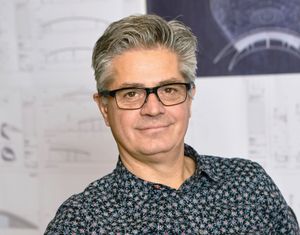
We caught up with architect Julian Gitsham in Dublin. Julian leads the global education, science team within Hassell, a multidisciplinary architecture, design and urban planning practice with offices in Asia Pacific and the United Kingdom.
How could the life science sector, the real estate sector and other key stakeholders work better together to create innovation districts?
The life sciences sector is a critical catalyst for growth and prosperity that delivers wider social and environmental impact beyond the immediate development cluster. We need to bring together collaborative relationships from both public and private investment partners, developers, clients, communities and the planning authorities to work together and deliver these visionary and transformative developments.Currently demand for high quality space in the UK is outstripping supply and there is a danger that if we don’t accommodate this demand then global talent will migrate elsewhere and the UK will lose its position as a leader in innovation. I also think the key to success is to understand the end-user and the type of spaces and facilities they need now and in the future. We also need to bring communities with us at every step of the process, understand and address their concerns, identify common goals and promote the
social and economic benefits of creating ‘Connected Communities’.
How can the physical/built environment encourage better innovation through collaboration between business, education, and communities?
The best innovation happens within connected communities where conditions are curated for interaction and information sharing. There is a global talent war to attract the best talent to innovation districts and they will
be attracted to places with access to high quality local amenities such as affordable quality housing, good transport infrastructure, leisure and food and beverage outlets.Creative partnership between the business, education sectors and communities are critical in creating truly transformative ecosystems and incubators for
innovation. Key to success is early stakeholder engagement and to identify clear shared goals at the outset of the project. Funding is clearly a challenge in the current economic climate and as an industry we need to be creative in identifying new funding sources and forming partnerships from
both the public and private sectors. Identifying potential risks and risk mitigation strategies is key to unlocking investment as is a clear return on investment roadmap.A recent example of this is in our completed final phase of a transformational multi-stage masterplan for the University of Brighton’s main Moulse coomb Campus which is an ambitious regeneration project and is
Hassell’s largest masterplan delivery for an education campus in our 80-year history. The masterplan spans across a 10 ha (24.71 acre) site and features
over 55,000 sq m (591,800 sq ft) of cutting-edge buildings & infrastructure, designed and delivered by Hassell.These include a new Business and Law School, Advanced Engineering Centre, the Mithras Student Village and the just completed landmark foot bridge, connecting the Campus and student village to the local neighbourhood,
community and the city. Consolidating five previously fragmented sites, Hassell’s holistic scheme supports the University’s aspiration to break
down the boundaries between academia, research, business and industry to create an environment that encourages learning anytime, anywhere.
What have we learned from COVID-19?
Hybrid working is here to stay and the way we use spaces at work has changed. Understanding trends in tech is paramount too as this will
determine the future of work and learning and in turn how spaces
might be used in the future. Flexible and adaptable spaces are key in the life sciences sector since the science of tomorrow is yet to be invented! Hassell has undertaken some great research into this. For example, we
recently published our Magnetic Workplace report which surveyed 2500 office workers in the UK, Australia, Asia and US.A key takeaway from the report is the office needs to become more like
home. Landlords and occupiers need to think about how to attract staff back into the office through better amenities whilst also offering the flexibility of working from home. Again a talent war is at play here and
businesses are competing for top talent. A company offering great wellbeing standards and amenities could be the deciding factor between talent choosing
company A over company B.
How does the ever-increasing importance of sustainability affect Hassell’s thinking?
We are in a climate crisis. The built environment is responsible for
contributing approximately 40% of C02 emissions, so reducing the impact of the built environment on people and planet is crucial to solving the problem.Sustainability is at the core of our business and is a key lens we look through in deciding whether to work with a client or not. On every
project we ask whether the clients sustainability goals are aligned with
our mission statement. We are also finding that the global investment
landscape is changing too and funders are demanding their clients demonstrate how they are going to meet ever more stringent sustainability targets on projects.The regulatory landscape is changing too and this is reflected in a move from designing for compliance to designing for performance. To further bolster our drive to delivering Net Zero projects, Hassell recently recruited a Global Head of Sustainability and she is driving our global efforts in regenerative design which we see as the stepchange we need to
make to be truly green. We have projects globally that demonstrate the highest level of sustainability credentials and we are seeing an increasing fabric first approach in the industry which is a good thing.Here at Hassell we are amongst other things looking hard at the smart use of materials and how we can help developing countries use best their natural resources and skills in a sustainable way for example our Bidi Bidi Music
& Arts Centre project in Uganda will collect rainwater through a huge funnel in its lightweight roof structure and instead of having a thick roof that radiates heat, this lightweight roof will actually cool down the building. In addition the walls of the centre will be built from compressed earth blocks with local expertise and resource made out of material excavated
right where the building is being built from.
What is the single thing that most clearly defines a Hassell building?
Our purpose is to design the world’s best places – places people love. The one thing that really defines a Hassell building is delivering design solutions that feel unanticipated yet obvious! Curiosity is key to this and we like to think that we ask searching questions to gain that critical
insight. We are pushy, but in a good way. We do not subscribe to a ‘house style’ or formulaic approach to design - rather we are united through a rigorous design process that brings together the best designers and thinkers in a unique process combining the power of creative design and strategic intelligence. The result is meaningful design that generates measurable value – and makes a lasting difference. Across our studios in Asia, Australia, the US and the UK, we challenge each other, our clients and our
ideas in a spirit of open-minded collaboration and exploration. We draw on our own expertise in research, strategy, technology and experience design as well as the latest insights from experts and partners from further afield
to surprise and delight our clients and create the world’s best places.
Can you recall an event or incident that made you radically change how Hassell operates?
Without a doubt the most recent incident has of course been Covid-19 which we had to respond to rapidly in order to ensure ‘business as usual’. Within a few weeks we had adapted, adopted, and very successfully utilised digital tools available to us to continue working but remotely in a global capacity. Looking back it was quite extraordinary how seamless the transition was
from a studio culture and a way of working to fully remote and all credit must go to our amazing IT and digital services team who made this work. We
then incredibly successfully continued in this way before shifting to a hybrid and agile pattern of working globally.We have reminded ourselves as we emerge from this period of time that we are ultimately a studio culture and this generates collaboration, social interaction and innovation in ways that entire remote working can’t do. But there is certainly a blend of both positive outcomes from both methods of working which we have been sure to adopt for the long term.
Over €200 billion has flowed into European life sciences start-ups and scale-ups over the past decade. This funding is powering innovation and reshaping the sector's real estate.