Transformation: From Rural Land to Campus to Green Science Park
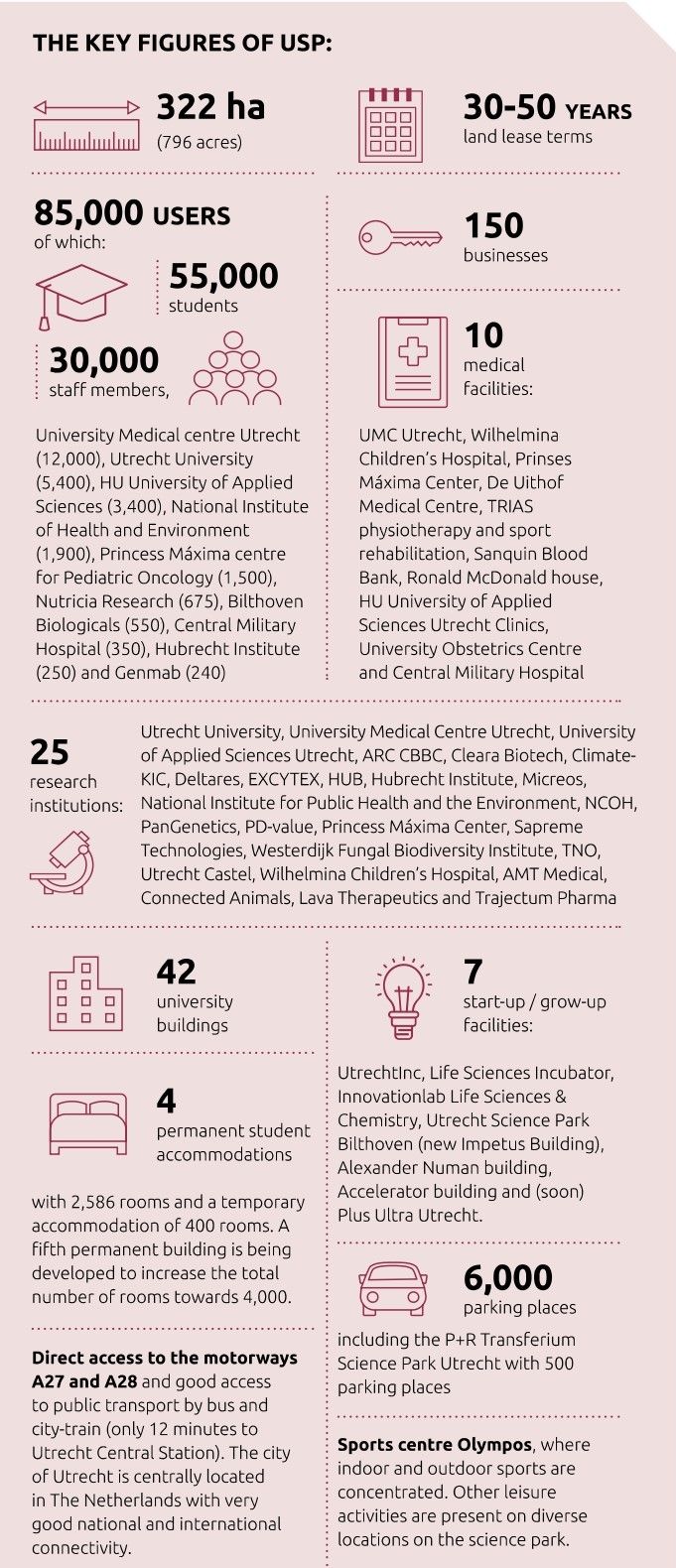
The start of the science park can be dated back to the late 1950s, when the University of Utrecht needed to relocate some of their faculties as there was no room for growth in the inner city of Utrecht. The Dutch government acquired rural land east of the city and created the neighbourhood “De Uithof ”, named after a local farm. The original urban plan focused on a small part of the neighbourhood and was designed with tight geometry, where the roads ran exactly north-south and east-west. The streets were named after famous foreign universities such as Harvard and Heidelberg. The first wooden educational buildings were erected in the Johannapolder near the farm “De Uithof ”. The neighbourhood developed further as more faculties from the Utrecht University relocated and also a broader range of educational institutions (HU University of Applied Sciences), hospitals, medical facilities, medical institutions, commercial companies and student accommodations were added. Furthermore, additional services were established to cater to the needs of the broader community. Since 1990 the development of the park was led by the urban development plan of Rem Koolhaas (OMA).In 2012 the foundation Utrecht Science Park was established by the owners of the land (Utrecht University, University Medical Centre Utrecht and the Municipality of Utrecht) together with the HU University of Applied Sciences Utrecht and Province of Utrecht. The aim of the foundation is to realise a leading international environment for the life sciences, health and sustainability cluster. The satellite location in Bilthoven was formalised in 2017 through the cooperation agreement with Poonawalla Science Park B.V. who is the owner of the 22 ha (54 acres) of land and its facilities. Cyrus Poonawalla Group (India) acquired the bio-engineering and pharmaceutical company Bilthoven Biologicals (BBio) in 2012, which has a focus on vaccine production. In 2018 the name of the neighbourhood formerly known as “De Uithof ” was formally changed to Utrecht Science Park.R&D focus on life sciences
USP has a focus on specific fields of life sciences research and development such as Personalised Medicine & Healthcare (image-guided interventions, precision health & medicine, specialised nutrition), Molecular Life Sciences, Regenerative Medicine & Stem Cells (organoids, biofabrication) and Healthcare Innovation (e-health, medical technology). The focus areas One Health (human health, veterinary health and healthy environment), Healthy Urban Living and Future Food overlap with Sustainability, the second pillar of the science park.The research and development in life sciences is supported through the Utrecht Centre for Entrepreneurship, which offers entrepreneurial programmes for students and staff and the Career Services programme facilitates traineeships for all types of students. The eco-system is supported by a broad array of educational programmes at Bachelor’s, Master’s and PhD level including an extensive range of English language programmes. The Graduate School of Life Sciences manages all education programmes in the life sciences area and has gained a strong international reputation in biomedical and life sciences education and research.Long term plans