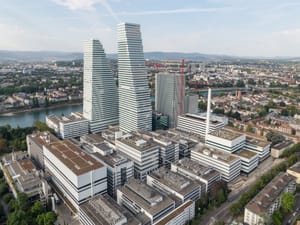

Glasgow is a city with a population of 635,000. It is the largest city in Scotland and the fourth largest in the United Kingdom. It is situated along both sides of the river Clyde, with most commercial and administrative activities on the north bank. Its port and river access supported successful trading with the Americas and Europe in the 18th century.
With the Industrial Revolution came coal mining, iron founding, chemical manufacturing, and, especially, shipbuilding, which developed in Glasgow early in the 19th century. The decline in heavy engineering and shipbuilding in the 20th century led to much greater industry diversity including advanced engineering, aerospace, IT and software development, renewables, science, and medical technology.
The city hosts several academic institutions, notably the University of Glasgow (founded in 1451), the University of Strathclyde (founded in 1796 as Anderson’s Institution and granted university status in 1964), Glasgow Caledonian University (founded in 1875 and granted university status in 1993), and the University of the West of Scotland. Greater Glasgow and Clyde NHS operates nine main hospital sites and 35 hospitals, including Queen Elizabeth University Hospital, Glasgow Royal Infirmary, and The Beatson West of Scotland Cancer Centre.
Glasgow is located 345 miles (555 km) north of London, a journey time of almost eight hours by car or 4 hours 30 minutes by train. Glasgow airport lies nine miles (14.5 km) to the west of the city centre and offers over 100 domestic and international routes with a flight time to London Heathrow of one hour and 20 minutes.
Glasgow science and innovation districts
Glasgow City Region has recently secured £33 million (€38 million) of accelerator funding from the UK Government’s Department for Science, Innovation and Technology. This will support 11 major innovation pilots across west-central Scotland. The city has three Innovation Districts: Glasgow City Innovation District (GCID), Glasgow Riverside Innovation District (GRID), and Advanced Manufacturing Innovation District for Scotland (AMIDS) all of which work in partnership to deliver on their respective strengths.
Glasgow sits at the centre of a proposed “Glasgow BioCorridor” running from the West of Scotland Science Park four miles (6.5 km) to the northwest of the city, to Pioneer Group’s BioCity located 13 miles (21 km) east of the city, just off the M8 to Edinburgh. The primary corridor includes the universities, research institutes and hospitals of Glasgow, although some commentators might also include the GSK facility in Irvine some 31 miles (50 km) southwest of the city and the Scottish Enterprise Technology Park in East Kilbride, 19 miles (30 km) southeast of the city. The BioCorridor brings the public sector, business, and academia together in the research, development, and production of pharmaceuticals, bioinformatics, and medical technology.
BioCity Glasgow - this former MSD (Merck) research facility is now part of Pioneer Group’s portfolio. The 20-acre (8.1 ha) site has pharma grade security and provides office and lab incubator space. Facilities include access to on-site to MHRA licensed controlled conditions, cryostorage, a compound management library and supporting amenities within a nurturing business community. Tenants include BioAscent, ILC Therapeutics, BDD Pharma, and Clyde Biosciences. Pioneer Group has recently received planning consent for two new buildings totaling 72,800 sq ft ( 6,764 sqm) to be completed in two phases.
Glasgow City Innovation District (GCID) - is a hub for entrepreneurship, innovation, and collaboration. Located in the heart of Glasgow City Centre, GCID is a partnership between Glasgow City Council, the University of Strathclyde, Scottish Enterprise, Glasgow Chamber of Commerce, and the Entrepreneurial Scotland Foundation. The district is home to more than 1,600 innovative companies and organisations with a slant towards the technolog y and creative sectors, but also incorporating the Health and Care Futures Initiative to capitalise on expertise in the fields of medicine innovation, health tech, data analytics, and artificial intelligence. GCID has several specialist clusters including 5G and advanced communications, fintech, health tech, industrial informatics, quantum, and space. It hosts four innovation hubs:
Inovo - is home to a broad range of innovative organisations including three UK catapults including Offshore Renewables, High-Value Manufacturing, and Connected Places. It is also home to four Scottish Innovation centres, namely CENSIS, Digital Health & Care Innovation Centre, IBioIC, and The Data Lab. Co-locating with these catapults and innovations centres is Spartan Solutions, Datalytics Technology, and M Squared Lasers.
South Block - is a four-storey former textiles warehouse that has been transformed into a 50,000 sq ft (4,645 sq m) studio complex. South Block offers over 90 studios for not only visual and applied artists but also cultural social enterprises and creative businesses.
Technology & Innovation Centre (TIC) - is the University of Strathclyde’s dedicated national and international centre for research, commercialisation, and business research and development. The specialist research groups based in the building have strong links with industry and work in collaborative teams to solve global issues across sectors including Energy, Health, Manufacturing, and Future Cities. The Centre plays a vital role in the exploitation of new and emerging technologies and helps bridge gaps between research, technology and commercialisation. TIC provides state-of-the-art research facilities and a flexible working environment which brings together up to 750 academics, researchers, postgraduate students and project managers. Developed with industry, for industry, the TIC has already attracted Scottish and Southern Energy, the Weir Group, Scottish Power, Fraunhofer UK, and several other major cross-sectoral industrial companies.
The Garment Factory – built in 1899, this listed architectural gem has been transformed through a £6 million (€6.9 million) refurbishment in 2017 that has retained many original features. The building now offers flexible tailor-made suites from single desks to HQ facilities and has attracted the likes of Channel 4, Shoosmith, and Katrick Technologies.
Glasgow Riverside Innovation District (GRID) - encompassing both sides of the River Clyde, GRID is a partnership between the University of Glasgow, Scottish Enterprise, and Glasgow City Council and comprises 700 acres (283 ha), much of it being brownfield land. GRID benefits from existing world class infrastructure, which will only be enhanced as the University’s main campus in the West End nears completion of a £1 billion ( €1.15 billion) redevelopment programme. It spans a corridor from the University of Glasgow in the west end, down to and across the river to the Queen Elizabeth University Hospital ( QEUH) campus. While host to numerous economic, cultural, and creative assets, much of the area is also home to deep-rooted deprivation and historical industrial decline, with the river seen as a significant barrier. To this end, GRID is driven by cocreation, engagement, community, and social value to promote inclusive growth, regeneration, and transformational change – with community benefits and impact seen as a key differentiator. The community and social value aspects are seen as a real positive by potential inward investors.
“Our plans will be for nothing if the innovation fails to produce tangible benefits for residents. Genuine success will be about changing the lives of local people for the better and creating well-paid, high-prospect jobs, and in doing so, find solutions to deliver transformational change” – David Duncan, Chief Operating Officer & University Secretary, and Uzma Khan, Vice Principal for Economic Development & Innovation, University of Glasgow.
GRID is home to the world-leading Clinical Innovation Zone based around Queen Elizabeth University Hospital, the largest teaching hospital campus in western Europe. The University’s long-standing and close working relationship with the NHS is identified as one GRID’s key strengths. GRID also hosts the university’s Advanced Research Centre (ARC) with over 500 leading researchers. The ARC aims to bring together researchers and ideas from across disciplines and sectors – the quadruple helix of academic, industrial, public, and civic – to unlock previously out-of-reach research. In May 2023, the Clarice Pears Building became the latest completion on the university campuses redevelopment programme. It will be home to the College of Medical, Veterinary and Live Science’s School of Health and Wellbeing. Plans are also being progressed for a new 124,850 sq ft (11,600 sq m) six-storey building to house the Adam Smith Business School and an on-campus Innovation Quarter on Church Street.
In addition, the University of Glasgow has been awarded a £38 million (€43.7 million) grant by UK Research and Innovation to create The Living Laboratory for Precision Medicine, and £16 million (€18.4 million) from City Deal funding for the Imaging Centre of Excellence. The Living Laboratory brings together academia, the NHS, private business and a willing public for clinical trials to test potentially disruptive innovations in a real-world clinical setting to facilitate quick and seamless adoption into the NHS. GRID clusters include precision medicine, clinical testing, healthcare innovation, creative and cultural, and tech start-ups. Occupiers include Aurum Biosciences, AstraZeneca, Causeway Therapeutics, Canon, Siemens, Clinnovate Health, Panthera, Objectivity, and Precision Medicine Scotland Innovation Centre.
Just recently, the University of Glasgow has signed a memorandum of understanding with GE HealthCare whereby the two organisations will work together to identify opportunities for collaboration in research and development, and innovation focused on people-centred healthcare and outcomes.
The collaboration builds on GE HealthCare’s expertise in medical tech innovation and the University’s research excellence alongside its strong links with the NHS.
Further, in March, the Scottish Government announced that GRID would become Scotland’s first whole-system testbed for innovation, committed to supporting the establishment of a series of real-world innovation testbeds – to be known as GRID Discovery. The concept is modelled on a similar successful initiative in Helsinki.
Paisley, Advanced Manufacturing Innovation District Scotland (AMIDS) - located close to Glasgow airport, 11 miles (17.5 km) west of the city centre, the AMIDS centre provides 1.6m sq ft (150,000 sq m) of floorspace for life sciences, advanced manufacturing, aviation services, logistics resources and manufacturing solution. It is home to the National Manufacturing Institute of Scotland (NMIS) and the Medicines Manufacturing Innovation Centre (see below).
The district also hosts major international businesses such as Rolls Royce, Thermo Fisher Scientific, Peak Scientific, Terumo Aortic, and Doosan Babcock.
Paisley, Medicines Manufacturing Innovation Centre (MMIC) – the £88 million (€101 million) centre opened in November 2022 and is equipped with advanced technical equipment and capabilities to allow scientists and companies to develop and manufacture small molecule medicines, fine chemicals, drug substances and drug products in a good manufacturing practice (GMP) environment. MMIC is a unique collaboration with 24 partner organisations from pharma, government, business, and academia. The six founding partners are: pharmaceutical leaders AstraZeneca and GSK, tech innovation catalyst CPI, strategic research partner, the University of Strathclyde, and the government agencies UK Research and Innovation (UKRI) and Scottish Enterprise. Additional partners invested in the centre include Pfizer, Novartis, Alnylam, PwC, Siemens, Applied Materials and Atos. The Centre is forecast to generate £200 million (€229 million) in advanced technologies over its first five years, creating high value jobs, enabling private investment, and building next- generation manufacturing assets and expertise.
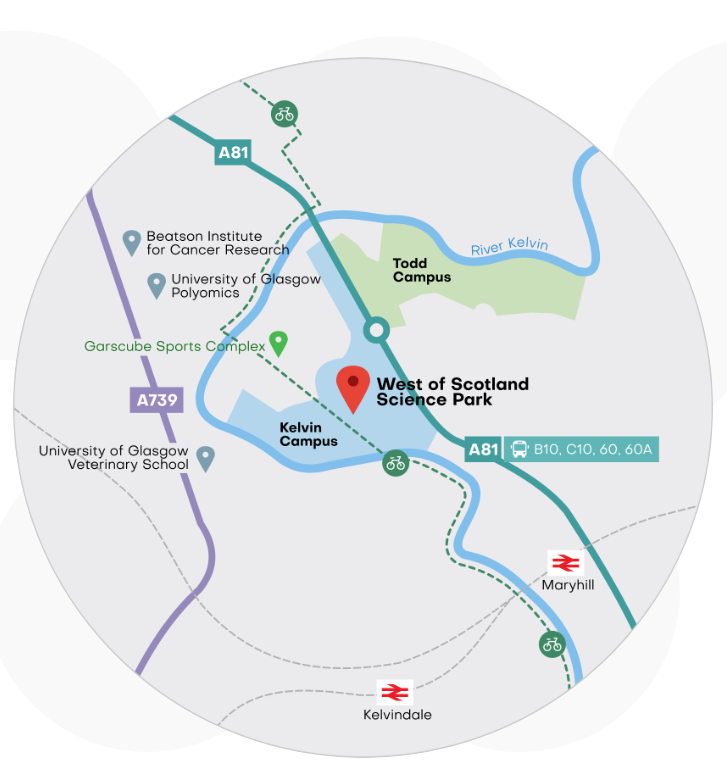
West of Scotland Science Park - The West of Scotland Science Park is a joint initiative between Scottish Enterprise and the Universities of Glasgow and Strathclyde and was opened in 1983. Located on a 61-acre (25 ha) site, the facility is divided into two campuses. The Todd Campus comprises 14 buildings which are predominantly occupied by companies involved in biotech, optoelectronics, and software development. The Kelvin Campus comprises nine pavilions and the three storey Venture building offering lab and office space. The Park is home to a wide range of companies operating across all areas of the life sciences and technology sectors including ultrasonics, pharmaceuticals, mobile computing, cleanrooms, satellites, laser systems, telecommunications, pre-clinical drug discovery and optoelectronics (a branch of electronics involving devices that emit, modulate, and sense light). Tenants include Amethyst Research, Merck Life Sciences, Sartorius, and R-Biopharm AG. It also benefits from its proximity to several leading research facilities, including the Beatson Institute for Cancer Research and the Translational Research Centre.
Key new developments in the city
Two developments stand out: the Met Tower and Charles Huang Advanced Technology and Innovation Centre (CHATIC).
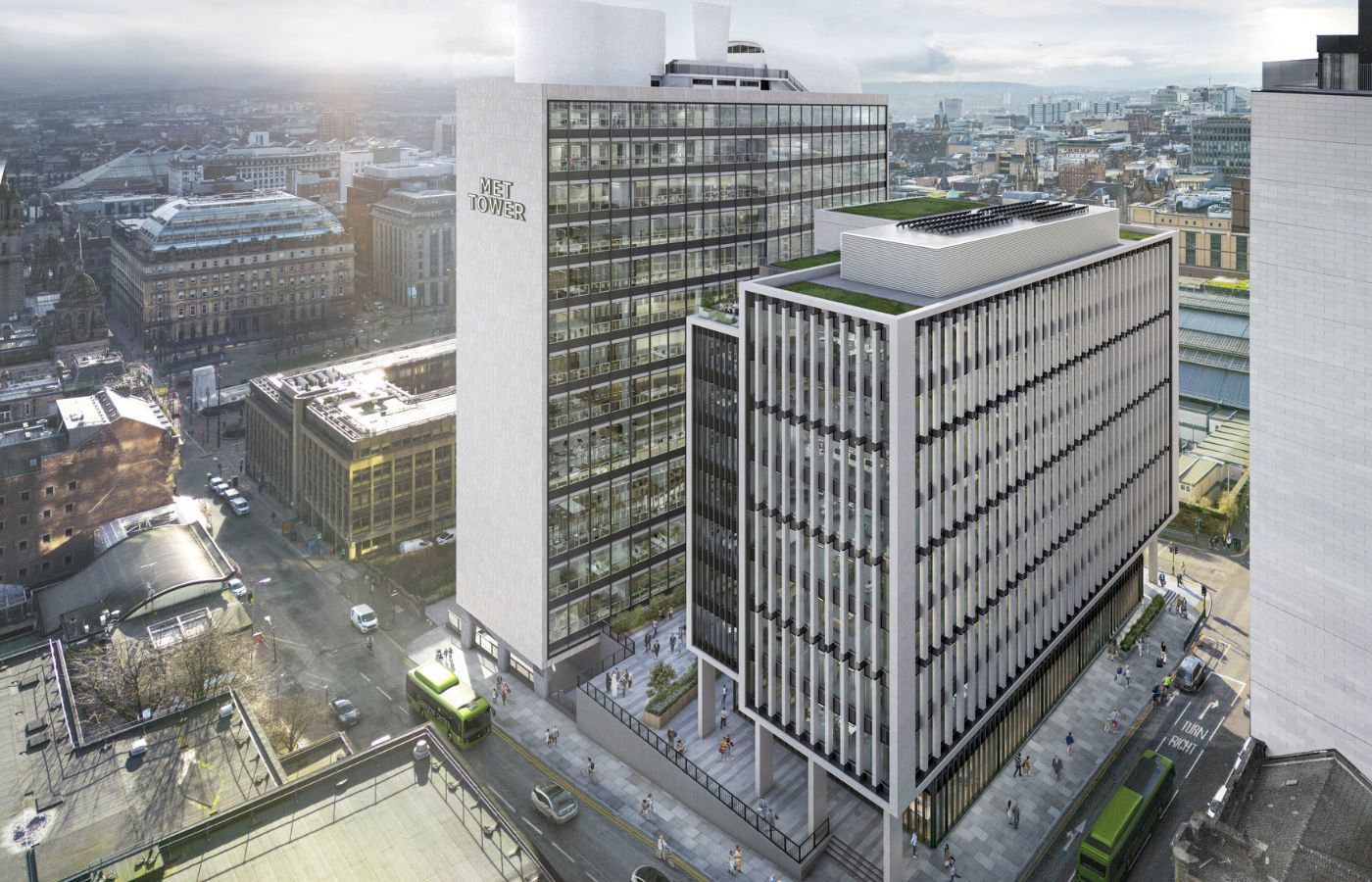
Met Tower, Glasgow City Centre
Bruntwood SciTech is proposing to transform Glasgow’s Grade-B listed iconic MetTower, located within the GCID. Its vision includes the refurbishment of the former City of Glasgow College building alongside a new, adjoining tower which together will deliver a new technology and digital hub in the heart of the city and Glasgow City Innovation District. Subject to planning, the £60 million(€69 million) investment will bring the existing block back into use in the summer of 2025, with the new build development online in 2026. Combined, the two towers will offer more than 200,000 sq ft (18,580 sq m) of serviced and leased office space creating a commercial hub where tech and digital university spinouts, startups, scaleups and high-profile tech tenants can co-locate and collaborate in best-in-class workspace.
Charles Huang Advanced Technology and Innovation Centre (CHATIC)
Following a £50 million (€57.4 million) gift from the philanthropic foundation of Dr Charles Huang in 2021, plans are being progressed for a new building in the heart of the GCID on land bordered by High Street, Ingram Street, and Shuttle Street. This will create leading-edge research space and relieve pressure on existing premises.
With two new major innovation districts, backed by strong academic, research and health services credentials starting, Glasgow could justifiably draw more attention to the life sciences, medical and healthcare related opportunities for the private sector. A city that has continued to evolve, Glasgow will see significant transformation as the GCID and GRID innovation districts gain traction in the coming years.