

Role of MedCity
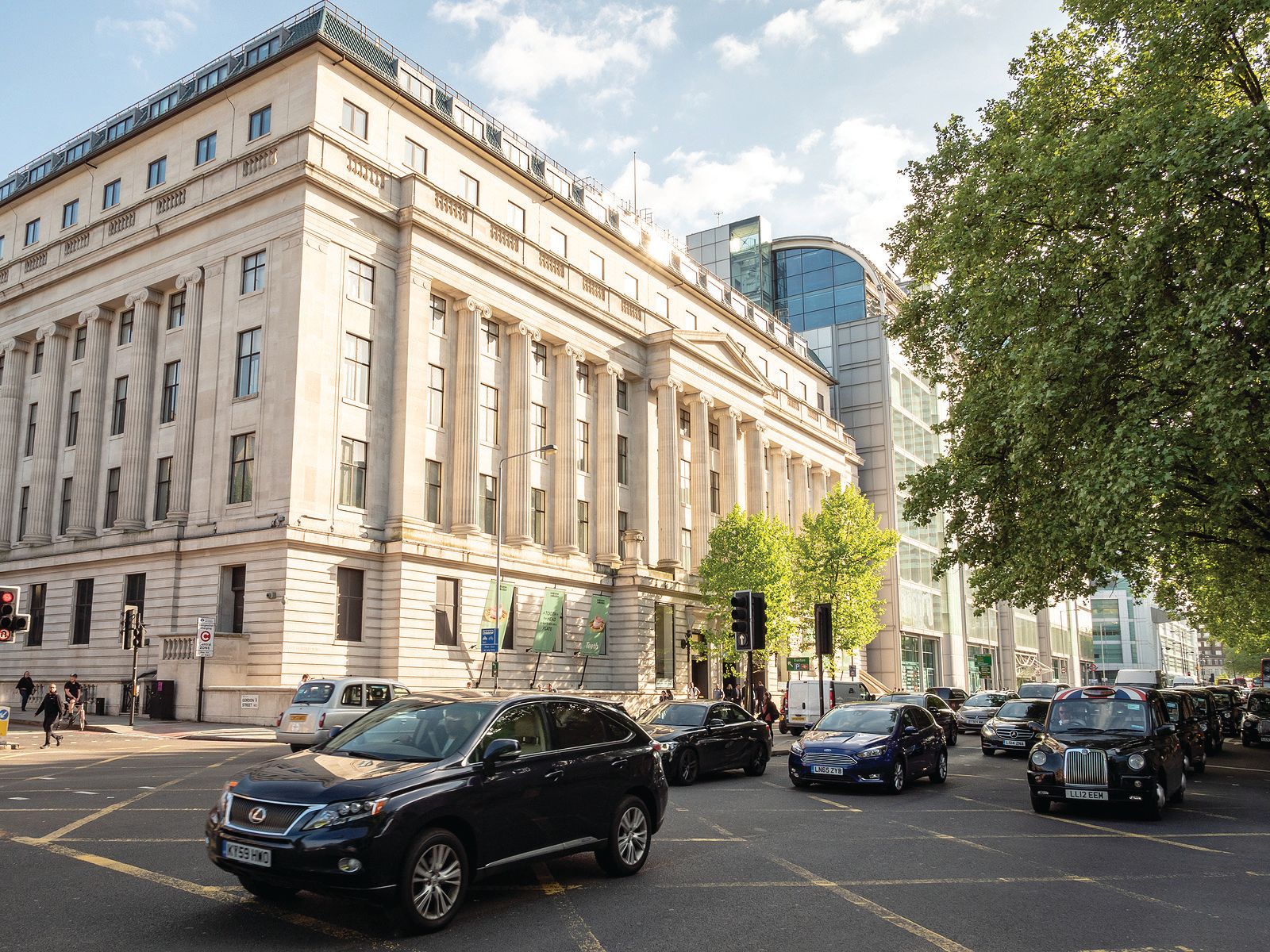
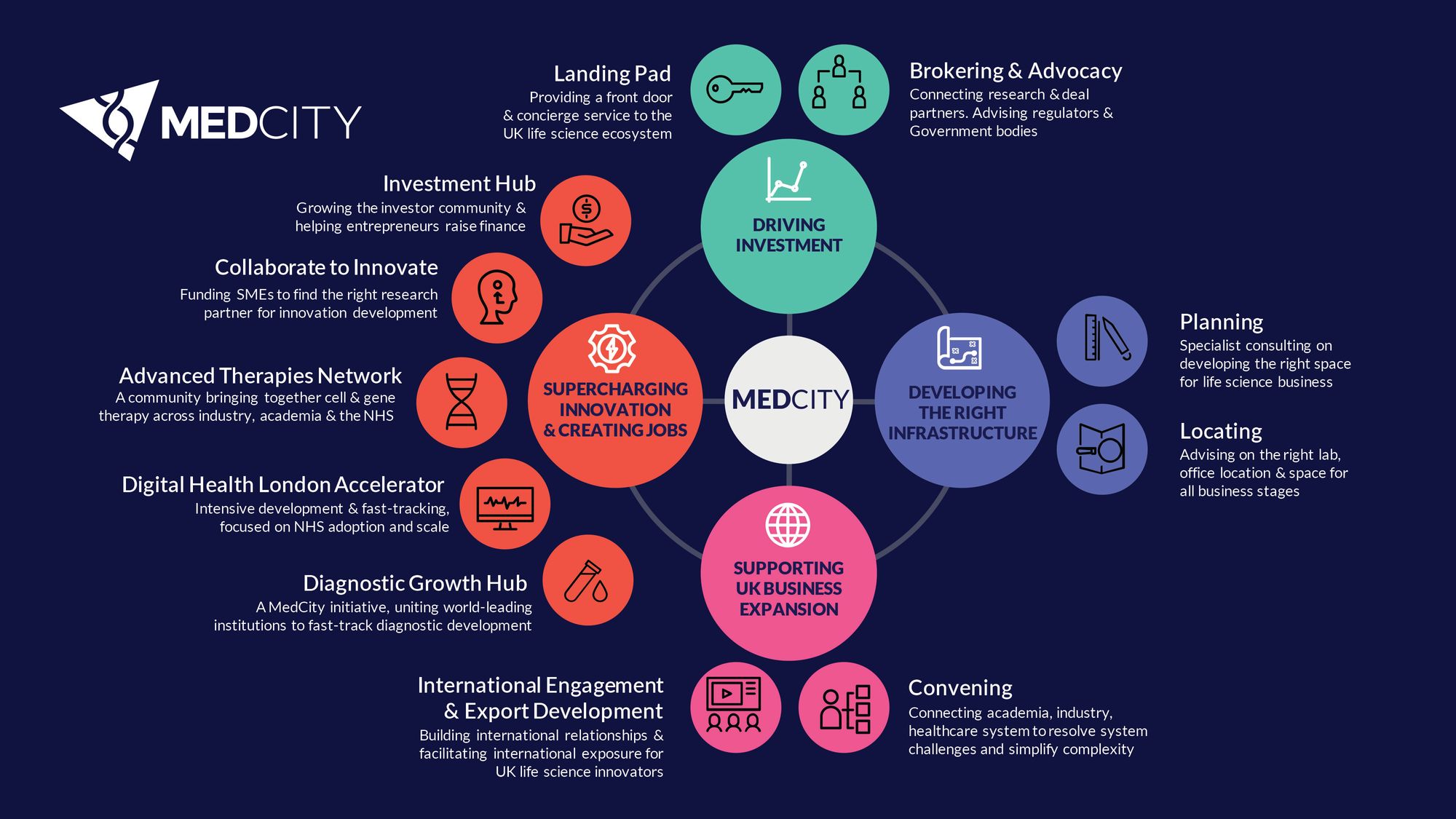
MedCity was established in 2014 by the Mayor of London in partnership with the city’s Academic Health Science Centres to drive growth and investment in the sector to benefit the health and wealth of the population. MedCity is a not-for-profit organisation supported by the Mayor of London, Research England, the Greater London Authority (GLA), and the European Regional Development Fund. MedCity creates and develops networks of innovators in industry and academia to navigate the complex London life sciences ecosystem. It connects private industry with partners in academic institutions, the NHS, and the charity sector to catalyse opportunities that advance cutting-edge R&D in areas such as AI, diagnostics, and rare diseases. MedCity also works closely with real estate developers, London boroughs, and the city’s established and emerging life sciences innovation districts to inform provision of infrastructure that meets the needs of the life sciences sector and the wider community. It is well positioned to oversee each sub-sector and to identify shared areas of focus and expertise that would benefit one another. CEO of MedCity, Neelam Patel, says, “A cohesive London offer is important for both national and international exposure. Competition drives innovation, so we’re not about reducing that competition; we’re about bringing clusters together to enable London to work cohesively as an entity both nationally and internationally. Exhibit 1 provides a more detailed template for the role of MedCity in four key areas: 1. Developing the right infrastructure 2. Supporting UK business expansion 3. Supercharging innovation and creating jobs, and 4. Driving investment.Exhibit 1: The role of MedCity
Overview of London clusters
Within the Greater London area there are arguably six established life science clusters at King’s Cross, White City, Southbank/SC1, Sutton, Hammersmith and Uxbridge. To these can be added the four emerging locations of Whitechapel, Canary Wharf, Paddington and Canada Water where current development activity and longer-term proposals will deliver space at scale.The Six Established Clusters
King’s Cross
The King’s Cross Knowledge Quarter (KQ) is an excellent example of life sciences located within an urban environment. Its one-mile (1.6 km) radius encompasses a 105-acre (43-hectare) area of King’s Cross, Bloomsbury, and Euston Road in London. It describes itself as “home to the world’s greatest knowledge cluster” and considers itself a unique urban cluster within a global city. The KQ has evolved around the Francis Crick Institute (FCI) and includes the Alan Turing Institute, University College Hospital, University College London (UCL), and the Wellcome Trust. The location captures a broad mix of science, tech, art, history, and culture. The KQ has multiple owners but, anchoring the FCI is a unique partnership between six of the world’s leading biomedical organisations, all of which originated in the UK – the Medical Research Council, Cancer Research UK, the Wellcome Trust, University College London, Imperial College London, and King’s College London. The KQ area employs 57,000 staff, including 3,000 scientists and 13,700 academics in addition to 98,500 students. Some of the partners in the KQ include Camden and Islington NHS Foundation Trust, City University London, Royal College of Physicians, and the Royal Veterinary College. The breadth of science and arts-related knowledge and talent promoted by these institutions, amongst others, is a critical element in the cross pollination of ideas and innovation. In addition to its academic credentials, the British Library and the British Museum, major life science occupiers at KQ include Astra Zeneca, GlaxoSmithKline, Wellcome Trust, and Gyroscope Therapeutics. The regeneration around King’s Cross station and Pancras Square will also accommodate a range of tech and media businesses, including Google’s new UK HQ, Facebook, DeepMind, and Universal Music. The urban environment around the KQ creates its own challenges in terms of accommodating the physical growth and expansion of existing occupiers and attracting new entrants within the confines of a dense urban streetscape, historic buildings, and a wary planning system. However, the demand for technical, flexi, and lab space is such that a number of new build and repurposing schemes are in play: British Library – Stanhope is developing a 2.8-acre (1.1 hectare) site north of the British Library to create 100,000 sq ft (9,290 sq m) of space for learning, exhibitions, and public use, plus a bespoke HQ for the Alan Turing Institute, and the national centre for data science research. The development will also include commercial space for organisations wishing to be located at the heart of the KQ. Tribeca – Reef Group and BlackRock Real Assets, on behalf of British Airways Pension Trustees, are seeking a development partner for the 3-acre (1.2 hectare) site. Five buildings are proposed for the 1 million sq ft (11,000 sq m) scheme to include offices, labs, and residential near the Regent’s Canal. 4 Brandon Road and 18-20 Tileyard Road – Kadans purchased the two assets in July 2022 with a view to delivering 230,000 sq ft (21,500 sq m) of life sciences space in a scheme that will cost £95 million (€103 million). Euston Tower – British Land is partnering with Allianz to deliver a development with an expected gross value of c. £1.5 billion (€1.8 billion). While plans are at an early stage, the strategy is to deliver life science space within the wider 13-acre (5-hectare) Regent’s Place estate.White City
White City, to the west of London, is now an established focus for biotech, digital, and creative businesses. The Imperial College campus is complemented by the adjacent White City Place, an urban campus development by Mitsui Fodosan, AIMCo, and Stanhope on the site of the old BBC HQ which was acquired by Cadillac Fairview in October 2020. The Imperial College development includes the Molecular Science Research Hub (MSRB), the Translation and Innovation Hub (I-Hub), plus the Michael Uren Biomedical Engineering Research Hub. The new 58,000 sq ft (5,400 sq m) School of Public Health premises will complete later in 2022. The campus is also home to Scale Space, a partnership between Imperial College and Blenheim Chalcot, which offers over 200,000 sq ft (18,600 sq m) of technology and innovation space, including wet and dry labs, aimed at high growth tech and life sciences businesses. The space facilitates Imperial’s incubator start-up companies to scale up on site.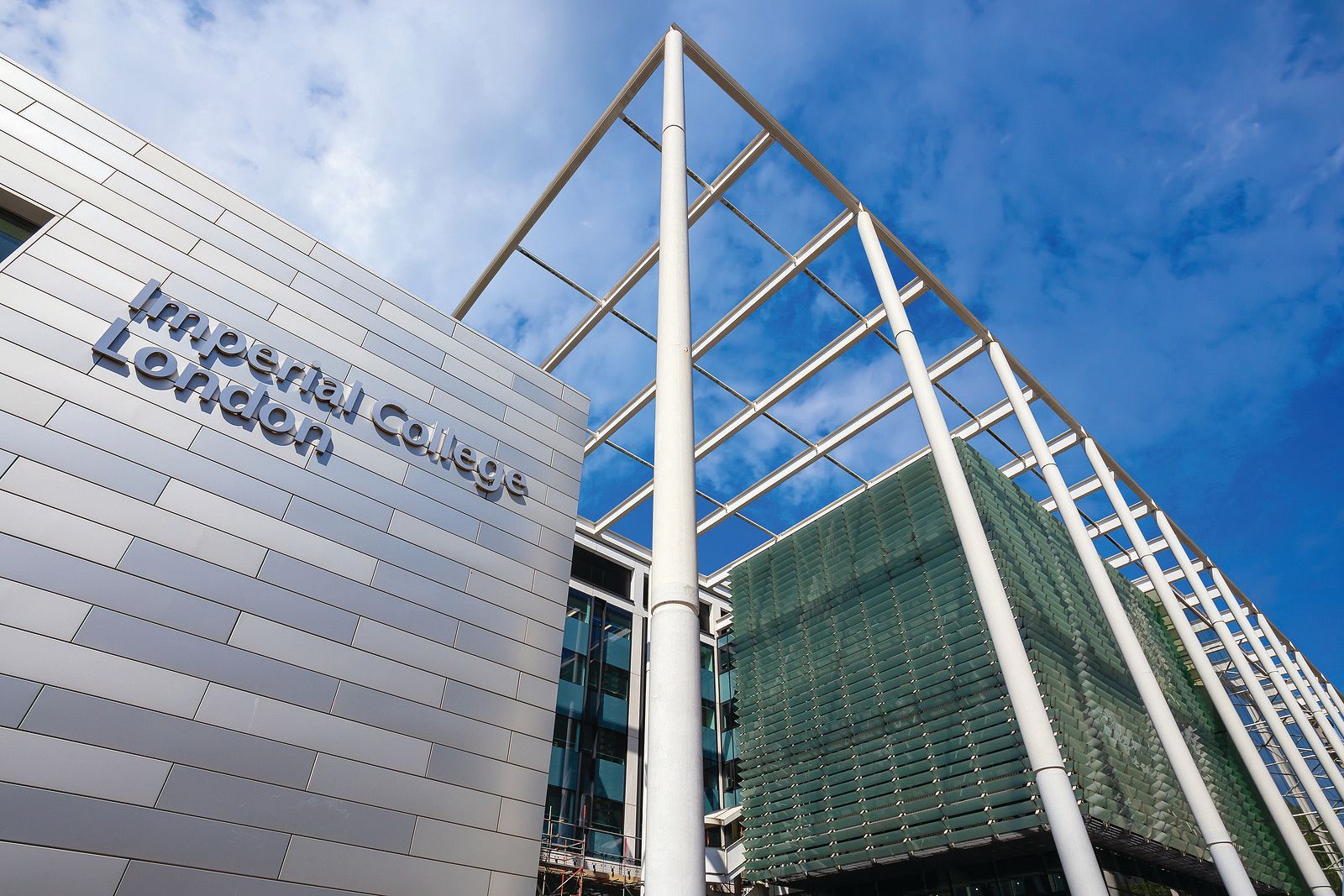
Sutton
Situated to the southwest of central London, Sutton Council together with partners theInstitute for Cancer Research (ICR), the Royal Marsden NHS Foundation Trust, the Greater London Authority (GLA), and Epsom St Helier University Hospitals NHS Trust, established a development framework in 2016 to transform the existing London Cancer Hub into a global centre for cancer innovation. The vision has the potential to deliver over 3 million sq ft (280,000 sq m) of modern science, healthcare, and office facilities across the district. Sutton Council will be seeking an investment partner to develop the next phase of the London Cancer Hub. A 12-acre (5-hectare) site, owned by the council, has the potential for 600,000 sq ft (56,000 sq m) of life sciences facilities with a gross development value of c.£500m (€425m).Southbank
The Southbank cluster is branded as SC1. Founded by King’s Health Partners, Guy’s & St Thomas’ Foundation, and Lambeth and Southwark councils, the vision is “to create a transformative life science ecosystem in south central London dedicated to innovation, creative partnerships and to improve life for our local and global communities”. Southbank is already home to the Cell and Gene Therapy Catapult at Guy’s Hospital, the King’s College AI Centre, and the Health Foundry co-working space. There are ambitious plans to create significant new spaces for health and life sciences, including: Royal Street – Stanhope and Baupost are the development partners for Guy’s and St Thomas’ Charity to bring forward a 5.5-acre (2.2-hectare) site opposite St Thomas’ Hospital. St Thomas’ is part of King’s Health Partners (KH), one of five UK Academic Health Science Centres alongside Imperial, UCL, Oxford, and Cambridge. The scheme will accommodate the Waterloo Health Innovation Hub that will provide outpatient facilities, clinical support space, and teaching and research facilities. Three additional commercial buildings are planned for larger space users, SMEs, and start-ups. Delivery of the first phase is expected in 2024/25. Snowsfields Quarter – Oxford Properties and Reef Group will invest c. £350 million (€471 million) as development partners for Guy’s and Thomas’ Foundation for a new 300,000 sq ft (27,900 sq m) health innovation cluster in three buildings on a 0.88-acre (0.36-hectare) site close to London Bridge. Vinegar Yard – CIT is developing a 185,000 sq ft (17,200 sq m) 19-storey life sciences-led scheme to accommodate NHS clinical or medical research uses. Designed by KPF architects, the development will meet Guy’s and St Thomas’ NHS Foundation Trust’s new Adaptable Estate Strategy for healthy and flexible buildings.ARC West London
ARC (Advanced Research Clusters) was launched as Brookfield’s real estate platform focusing on science, innovation, and technology in May 2022.
ARC West London in Hammersmith was formerly known as Manbré Wharf, Hammersmith, and is an integral part of the wider West London life science ecosystem, close to Imperial College’s medical training and research campus within Charing Cross Hospital, and in close proximity to the internationally acclaimed Institute of Cancer Research, Imperial College London’s White City Campus, and Hammersmith Hospital. It is located under six miles (9.5 km) west of central London on a prime site fronting the river Thames. The location has good connectivity via the Piccadilly, District, Circle and Hammersmith and City underground lines.
The Waterfront building is 122,364 sq ft (11,369 sq m) is undergoing some refurbishment to cater for a mix of office and lab tenants. Part of the ground floor is occupied by ARC’s Motherlabs accelerator and incubator space, approximately 11,000 sq ft (1,013 sq m) of fitted level 2 labs. With the existing Motherlabs space fully let, there are plans to provide additional facilities. Current tenants include Epsilogen and Sania Therapeutics.
The Refinery is a redevelopment and extension of the second Manbré Wharf building. The Refinery will provide 150,000 sq ft (13,937 sq m) of flexible lab-enabled facilities, ranging from 700 sq ft (65 sq m) to single or multiple floors. Motherlabs will occupy c.12,500 sq ft (1,161 sq m) on the ground floor. Floors one to four will provide flexible floorplates of close to 27,000 sq ft (2,509 sq m). Amenities will include restaurants and cafés, access to landscaped riverside frontage, and event and presentation studios suitable for science and tech SMEs to multinationals. Completion is due in Q4 2024.
ARC Uxbridge
ARC Uxbridge is a leading business and innovation campus offering best-in-class office and lab space within easy access of London (20 miles / 32 km) and Uxbridge town centre. Uxbridge is located at the end of the Piccadilly and Metropolitan underground lines, a 20-minute walk or a shuttle bus ride away from the campus.
Set in 50 acres (20 ha) of parkland, the campus provides over 300,000 sq ft (27,873 sq m) of high-quality office space, including ARC’s Adapt serviced offices product. Building 01 is currently being marketed and comprises 81,947 sq ft (7,613 sq m) of Grade A offices. The Clubhouse provides a range of supporting amenities. Major tenants include Bristol Myers Squibb, Daiichi-Sankyo, and Amgen.
The Four Emerging Clusters
Whitechapel
Located on the City fringe, the emerging Whitechapel cluster is focused on Queen Mary University of London (QMOL), Barts NHS Trust and the Royal London Hospital. The area hosts one of only three purpose-built commercial laboratory incubators in central London (Queen Mary BioEnterprises Innovation Centre), and the Queen Mary Enterprise Zone has launched an innovation space dedicated to the growth and scaling up of digital health, medtech and AI SMEs. The development pipeline includes: Whitechapel Road Life Science Cluster – NHS Property Services, on behalf of the Department of Health and Social Care (DHSC) has submitted a planning application for a 3.4-acre (1.4 hectare) site next to Royal London Hospital. The NHS is believed to be looking to secure an outright sale of the land as a precursor to the development of an 800,000 sq ft (74,000 sq m) research-led campus. Royal London Hospital – Lateral has purchased a 0.5-acre (0.2-hectare) site next to Royal London Hospital and will submit a planning application to develop a life sciences facility later in 2022.Canary Wharf
Less than four miles (seven km) east of the City, Canary Wharf is traditionally known as a hub for financial and business services, but it has been diversifying its tenant base for some years. Canary Wharf Group’s (CWG) Level39 initiative, launched in 2013 to support fast-growth tech companies, now occupies three floors and 80,000 sq ft (7,400 sq m) in One Canada Square. Further diversification is planned following the March 2022 announcement of a CWG and Kadans Science Partner JV to develop a 22-storey, 750,000 sq ft (70,000 sq m) wet-lab enabled tower on the 8.2-acre (3.3-hectare) North Quay site next to the Elizabeth Line station. To be delivered in 2026, the development will form the first phase of a world leading centre for health and life sciences.Paddington
Paddington is located to the west of central London and has benefited from significant commercial regeneration in recent years. The recent announcement of a major life sciences initiative will further strengthen the area’s appeal. Paddington Life Sciences – anchored around Paddington’s St Mary’s Hospital, August 2022 saw plans announced for a 3 million sq ft (0.28 million sq m) healthcare and life sciences complex. This will include a full redevelopment the St Mary’s estate and an additional 1.5 million sq ft (140,000 sq m) of cross-functional commercial and lab space. At the time of writing, no development partner has been confirmed.Canada Water
Canada Water in south-east London is the 53-acre (21.4ha) site which British Land and its JV partners AustralianSuper are transforming into London’s first new town centre in 50 years. Over the next 12 years, the masterplan will deliver a new high street and town square, up to 3,000 new net zero carbon homes, and 2 million sq ft (185,820 sq m) of workspace, including laboratory and flexi space to accommodate the growing science and tech sector in London.
The plan also includes 12-acres (4.8ha) of new public space, including a 3.5-acre (1.4ha) park, revitalised wetlands and a new town square. A key attractor for businesses is access to talent, where Canada Water scores highly, with more under-35s living within a 45-minute commute than almost any other part of London. There will be 33,000 sq ft (3,066 sq m) of “portable / pre-fabricated” labs to service current demand and potential for 300,000 sq ft (27,870 sq m) of further lab enabled space at Printworks.