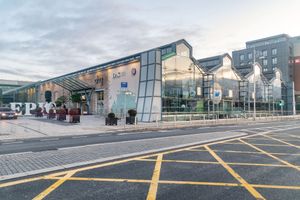
Dogpatch Labs is a start-up hub located in a huge 200-year-old warehouse called the CHQ Building in Dublin’s docklands. (CHQ refers to nearby Customs House Quay.) Dogpatch Labs share the building, which measures 155 by 55 metres (508 by 180 feet) with a museum called EPIC The Irish Emigration Museum and several retail outlets.
Members of the Dogpatch Labs community have access to flexible workspace; mentoring and training from founders, entrepreneurs and investors; networking and collaboration events. In 2020, Dogpatch Labs was awarded the €17m tender to manage the National Digital Research Centre, the early-stage start-up
accelerator for globally ambitious entrepreneurs that is backed by the Irish Government.
Start-ups located there are drawn from the life sciences and wider tech sectors. Here is a sample of current members and alumni: Jinga Life (digital health for use at home, Teckro (clinical trial software), Cumulus Neuroscience (neuroscience diagnostics), Beats Medical (central nervous system and rare genetic conditions), Empeal (digital health), Medosync (healthcare billing technology), Radmol AI (healthcare diagnostics using AI), Woebot Health (mental health app)
Dogpatch Labs is part of a global network of such hubs run by Google for Start-ups.
Origins
This industrial structure dates from 1820. External walls of Georgian brickwork enclose an area of approximately 8,500 sqm (91,440 sq ft) and the structure has a slate roof supported by a sophisticated, innovative cast iron frame.
The earliest map showing the building is from 1821. This map was enclosed in ‘An Historical Guide to Ancient and Modern Dublin’ (1st edition). The author notes: “In this store, which is now completed and in use, there is not one particle of wood or other combustible matter. There are nine vaults beneath, which altogether afford perfect and convenient storage, these vault are lighted by means of thick lenses set in iron plates in the floor of the tobacco store, but this is not sufficient to supersede the necessity of candle light.” No wood was used in the construction to ensure it was absolutely fireproof and it was used to store tobacco, tea and spirits.
In 1856, an enormous banquet for 4,000 people was held there,to welcome soldiers back from the Crimean War. The amount of food and drink consumed was staggering: “There were laid 250 hams, 230 legs of mutton, 250 pieces of beef, 500 meat pies, 100 venison pasties, 100 rice puddings, 250 plum puddings weighing one ton and a half, 200 turkeys and 200 geese, 2,000 rolls, 3,500 lbs of bread, 3 tons of potatoes, 8,500 quart bottles and 3,500 pint bottles of port.”
Restoration
Over its 200-year life the building has been dedicated to many different uses and its current incarnation is multi-use: Dogpatch Labs, retail, and cultural.
The Grade One protected structure was sympathetically restored by the Dublin Docklands Development Authority in the early 2000s. The restoration project included the innovative and immense glass facade, which now frames the southern end, and faces the River Liffey.
The vaults within the CHQ building are vast and consist of brick arches and limestone walls. All brick and stone surfaces had to be cleaned methodically using fine brushes with the final pass requiring a vacuum clean. Bricks were repaired by either replacing them with a matching brick or repairing them in situ using a colour matched repair mortar.
A number of alterations were also required within the vaults to make the building fit for its intended purpose. Of particular note was a new opening on the west elevation that involved the formation of a new granite stone arch and cast-iron door to precisely match the original and existing door arches on this elevation. The architects charged with the restoration (MCA Architects) won the 2008 RIAI Best Conservation project award for their work.
Data science is an important part of life sciences
Life sciences research and development relies increasingly on data scientists or, as Simon Farnsworth puts it in his interview: “it’s not just test tubes and Bunsen burners and people in white coats”. Start-up companies sometimes split the location of their teams, with the
data scientists working in tech start-up hubs like Dogpatch Labs, while their colleagues who need access to wet labs are located elsewhere (for example, in an on-campus incubator). Several of the Dogpatch Labs companies have second locations (for example, in Boston, India or the UK).
As companies scale up, they may be able to unite the whole team in one location but, in the interim, start-up hubs without labs are an attractive option for the data science team members who do not need access to wet
labs. In this scenario, their location of choice may well be a city centre one like Dogpatch Labs or King’s Cross in London or central Berlin rather than a “field in Kent”, to quote one disgruntled UK scientist.
The best of both worlds would be incubators with labs in the city, but these are currently less common. However, this could change because repurposing in urban areas will become more important as ESG and carbon zero goals prevail.