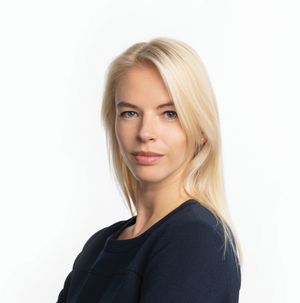
We caught up with Karolina Karl who leads the life sciences team at Invest Lithuania, the country’s inward investment agency. Invest Lithuania describes itself as a one-stop shop that informs, connects and supports foreign companies in Lithuania, all free of charge. Karolina is based at
Invest Lithuania’s headquarters in Vilnius.
Tell us a bit about your own background.
I have been with Invest Lithuania for almost six years, starting as an intern and then moving through different roles before becoming the head of the life sciences team in 2021. In my first role I concentrated on advanced
manufacturing and my focus has since broadened. The macro background to my current role is that in 2018 the government set out a strategy to increase the gross domestic product (GDP) contribution of the life sciences industry from 2 per cent to 5 per cent over the next decade. Before joining Invest Lithuania I studied international business and communication at the ISM
University of Management and Economics in Vilnius.
When supporting the life sciences sector, what is the no.1 policy priority?
Being able to adapt quickly to the industry’s needs is really important. We have identified five key areas to focus on: cell and gene therapy, advanced manufacturing, artificial intelligence, single-use disposable products, and medical devices. Another key focus for us is sector development, namely, encouraging expansion by those companies that have already established a base in Lithuania. Enhancing the regulatory environment and providing tools
to keep us up with the competition is part of this.
As a sector, why is life sciences important?
For me personally, life science is very important because it helps people to live better and healthier lives. Regarding my country, Lithuania has an ambitious goal to become one of the leading countries in life sciences in the Central and Eastern Europe (CEE) region by 2030, and Lithuania has already paved the way for this to happen.
Within life sciences, have you targeted specific areas?
Artificial intelligence and software development in a medtech context is of particular interest to us.
Are you competing with other national governments? If yes, which ones in particular?
On the global stage, Lithuania as an EU country competes with many other EU countries for investors that are seeking a location within the single market. Where life sciences companies are using cost criteria to guide their
choice of location, we compete with two other CEE countries – Poland and Hungary. Where life science companies have complex regulatory demands
driving their decision, we tend to compete with Ireland, Germany and Switzerland. Our main competitive advantage is our ability to respond to incoming companies individually. The Lithuanian government can offer
exceptional support to companies, such as a zero rate of corporation
tax for 20 years for companies that invest over €20 million in capital expenditure and create 150 new jobs.
In geo-spatial terms, are there specific cities or clusters that are prioritised?
Vilnius the capital (population 541,000) has a clear focus on biotech and pharma while Kaunas (population 298,000) is more about medical devices; however, these two cities are just one hour’s drive from each other, so we treat them as a single cluster.
Does the Lithuanian government prefer investing alone or in partnership?
There is a strong preference for public-private partnerships and there is also considerable emphasis put on continuing dialogue with the academic
community. We believe strongly in the triple helix model (where academia, industry and government work together to foster economic and social
development).
Will the country need to build more specialist space (e.g., labs, manufacturing, storage) to support life sciences?
Yes, Lithuania needs more specialist manufacturing space and R&D space too. Lab space that can be rented on flexible terms is good for attracting
innovation talent. For example, Kaunas is currently building R&D space, while the Vilnius City Innovation Industrial Park is developing a unique investment area for innovative research and experimental development
(R&D) in Vismaliukai. This area is situated to the northeast of Vilnius city centre. The industrial park is run by Northtown Vilnius, a public institution established by the national government and Vilnius City.
What is the single greatest challenge you face?
Awareness. Lithuania is a small country with a population of just 2.8 million, so it is not necessarily the first country people think of when considering life sciences.
Is the public generally supportive?
The government has a clear goal to grow life sciences from 2.7 percent of GDP to 5 per cent and the public is very supportive of that goal.