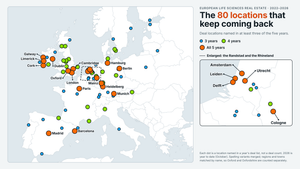


In Staying power, we found that of the c. 480 locations in our deals database since 2022, just 80 recorded deals in at least three of the five years. These persistent 80 account for about seven in ten deals. Twenty locations went further, recording deals in every year since 2022. This Five-Year Club accounts for almost half of all deals on its own. Here we look at what kinds of buildings change hands in those 20 locations.
The chart below ranks the cities by R&D’s share of their deals, from most to least lab-focused.
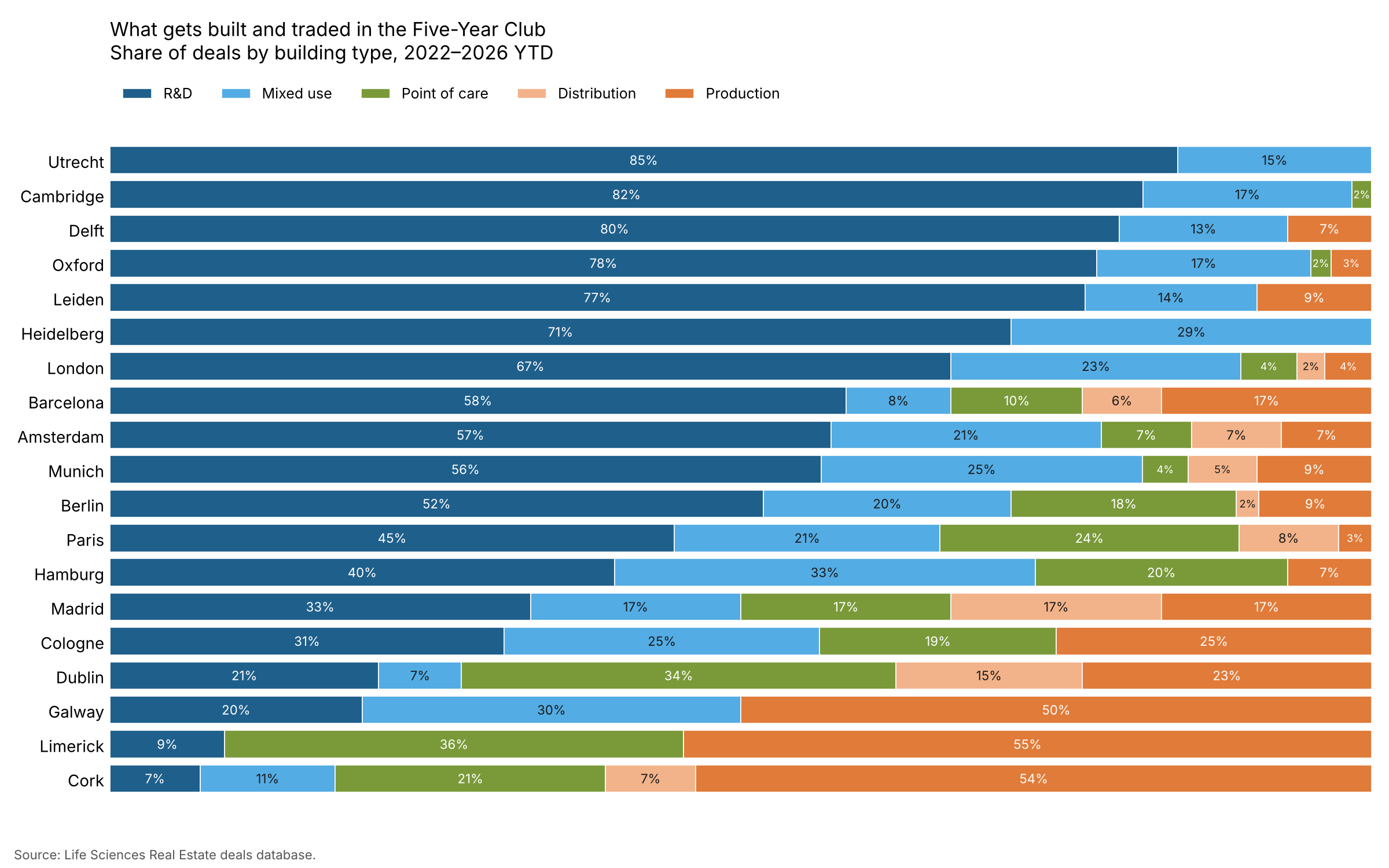
1. University towns with science parks dominate the top. R&D accounts for 77–85% of deals in Utrecht, Cambridge, Delft, Oxford and Leiden. Each has a leading university and a long-established science park, where research spills out of the lab and into companies. Cambridge Science Park and Leiden Bio Science Park are among Europe’s oldest and largest. Production, distribution and point-of-care facilities barely feature.
2. London is the least lab-dominated of the golden triangle. R&D makes up two-thirds of deals and mixed use almost a quarter. In London, labs often share buildings with offices and other uses.
3. Ireland’s provincial cities are built on production. Production accounts for around half of deals in Galway, Limerick and Cork, at least twice its share in any other city in the club. That is the legacy of decades of pharma and medtech manufacturing investment.
4. Point of care turns up in most cities. Clinics, hospitals and other point-of-care buildings appear in three-quarters of the 20 locations. In Paris it makes up almost a quarter of all deals, nearly all of them sales, and the keenest buyers are SCPIs, France’s retail-investor property funds.
5. Distribution is the rarest type, but it becomes more common further down the chart. It is absent from the university towns, reaches single-digit shares in Barcelona, Amsterdam, Munich and Paris, and peaks in Madrid (17%) and Dublin (15%), probably reflecting their role as national hubs for getting medicines to market.
6. The bigger the city, the wider the mix. Nine of the 20 cities have deals in all five building types, mostly capitals and big commercial centres such as London, Paris and Munich. The university towns have deals in fewer categories. Size, more than specialism, decides the range.
Every one of these cities has staying power, but each for its own reasons. Some are built around labs, some around factories and some around clinics, while the biggest trade in a bit of everything.