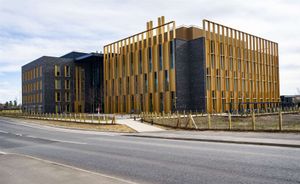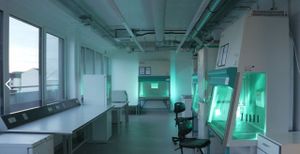

British Land is increasing its exposure to the life sciences real estate sector and has a programme to deliver 1.9m sq ft (176,530 sq m) of lab and innovation space.
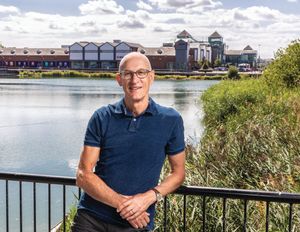
We met with Roger Madelin, Joint Head of Canada Water, for an informative chat and tour of the 53-acre (21.4- ha) site which British Land and its JV partners AustralianSuper are transforming into London’s first new town centre in 50 years. Over the next 12 years, the masterplan will deliver a new high street and town square, up to 3,000 new net zero carbon homes, and 2 million sq ft (185,820 sq m) of workspace, including laboratory and flexi space to accommodate the growing science and tech sector in London.
The plan also includes 12-acres (4.8ha) of new public space, including a 3.5-acre (1.4ha) park, revitalised wetlands and a new town square. A key attractor for businesses is access to talent, where Canada Water scores highly, with more under-35s living within a 45-minute commute than almost any other part of London.
Tell me about how British Land got involved in the life sciences real estate sector.
We knew that further education was a very important part of cities and the example of Central St Martin’s College locating at King’s Cross made the real estate industry think about higher education and its attractiveness to business. This coincided with colleagues coming back from the Boston / Cambridge area of the US and talking about Harvard and MIT driving business clusters with an emphasis on health and life science. Universities were suddenly seen as a major source of talent and catalysts for attracting other businesses. Our industry went from ignoring higher education, to “if you’re undertaking anything of scale, you need to be associated with higher education”. It was then a case of looking at the fundamental drivers behind the life sciences sector that are creating an ongoing demand for appropriate high-quality space – in London in particular. We had already delivered lab-enabled space at Regent’s Place, near King’s Cross Knowledge Quarter and following discussions with several London academic institutions and NHS estates, it became clear that their research expansion requirements could not be easily accommodated within the existing parameters of their complex land holdings.
This brings us to Canada Water, which is literally four minutes on the underground to Guy’s Hospital, eight minutes to St Thomas’ Hospital, six minutes from Royal London and 10 minutes from King’s College Hospital at Denmark Hill. There isn’t anywhere else in London that is that close to so many major teaching hospitals and we have 53-acres (21.4ha) to deliver whatever space is required. We have already delivered 33,00 sq ft (3,066 sq m) of modular labs adjacent to The Engineering & Design Institute (TEDI- London), a higher education enterprise founded by King’s College London, Arizona State University, and the University of New South Wales, Sydney (UNSW) and we are in the process of working up further plans that could accommodate a further 470,000 sq ft (44,214 sq m).
Do you see life sciences real estate as a growing part of British Land’s portfolio?
Yes. If you think that London and other parts of the UK will tend to follow what’s happened in the States – and the fundamentals driving growth here are, in some cases, better than in the US – then we see opportunities in London, Cambridge and Oxford.
Does British Land have any ambitions to expand its life sciences presence outside of the Golden Triangle?
There are strong academic institutions in the regions, but we have enough to work on in London, Cambridge, at Peterhouse Innovation Park and a couple of retail warehouses with the potential to convert. We are also looking into opportunities in Oxford. Having said that, we are close to announcing a 60,000 sq ft (5,575 sq m) letting to a life science occupier at Priestley Business Park in Guildford.
How do you define a life science property at British Land?
Well, it’s a building that provides a flexible chassis, with decent floor loadings, good floor to ceiling heights and vibration controls. We are learning pretty quickly, like everyone else, and draw upon experts in the field. Every occupier that we’ve spoken to has different requirements, whether its power, extraction, gas supply, vibration controls, etc., which keeps you on your toes. The challenge has genuinely rejuvenated my workspace interest.
Would British Land consider a building conversion – office or industrial to lab, for example?
Yes, we would. At Canada Water we have Printworks, a building that was occupied by the Daily Mail, and has more recently been used as a club and live music venue. This building has “good bones”, with 4-metre floor-to-ceiling heights and has the potential to accommodate 170,000 sq ft (15,795 sq m) of office, lab, and flexi space, while also retaining the event space. Adjacent to Printworks we are having designs prepared for site H3, which would provide 300,000 sq ft (27,873 sq m) of lab enabled space.
Do you employ specialists from a science background to assist with the understanding of the diversity of occupier needs?
The simple answer is “no”, although that’s not to say that we wouldn’t employ someone in the future. What we have done is form an Innovation Advisory Council that includes five leading academics and executives. Lynn Gladden, Shell Professor of Chemical Engineering at the University of Cambridge and Non-Executive Director at British Land, chairs the Council. Between them, the Council has experience across life sciences, healthcare, energy transition technologies, future telecoms, and venture capital. We are good listeners.
How important is the adaptability of the building?
It’s important, and we’ve learned from operators like BioMed Realty. The development on site H3 will accommodate the flexible chassis approach – high floor to ceilings, vibration controls, vertical ducting, and extraction. And it costs money to build in this flexibility.
How do you think life sciences real estate compares with more traditional forms of commercial real estate?
Well, it’s certainly more expensive to develop these flexible buildings. I think the jury is out in terms of investment returns, but if you look at the projections of opportunities in health, science, and technology, we think that it’s worth taking the risk. With development you are looking at least three years out, sometimes five or more years. When you make your decisions, you are basing them on the broader macro trends regarding health and demographics. Everything points to life science and health being a massive area of growth.
How important is ESG in British Land’s strategy?
We take it at least as seriously as others in the industry. We work very closely with our partners on the materials and construction side. I think on the social side, British Land is probably ahead of many, having pursued policies with community, schools, training, sports, well-being, and volunteering for many years now. Personally, I haven’t met a company that is better than British Land.
Given the current market volatility, do you see any issues in terms of liquidity for the life sciences real estate sector?
I think it’s not just life sciences. Fundraising for some of the new science and innovation businesses is proving difficult. There’s a lot of money around but those with the money are asking more questions about where to in vest it. And the answers to those questions are not so clear, given various external global factors. At British Land, we are well capitalised, but there is a concern over what is happening in the US lending markets and what further impact that might have on UK valuations. Have we reached the bottom? Nobody really knows. But for our quality product, we see high occupancy rates and rents rising, so if we have reached the valuation trough, sentiment and performance will improve. As for the life sciences and innovation sectors, we believe that the medium-term fundamentals are strong, and we intend to position ourselves to take advantage at the appropriate time.
With 1.9 million sq ft (176,530 sq m) of life science and innovation space in the planning and development pipeline, British Land is positioning itself to take advantage of the medium- to long-term macro trends that are continuing to drive the demand for high quality science and tech space with access to a sizeable talent pool.