
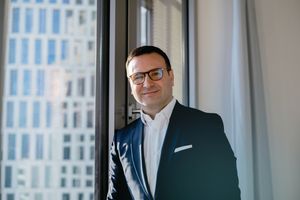
DRIVEN is a specialist investor, developer and operator for the science and innovation sector. We caught up with Toğrul in his office in Berlin.
Tell us a bit about yourself and your background.
I have been with DRIVEN Investment as a Managing Director since Day 1 in December 2018; therefore, I was able to witness all stages of our growth strategy to date. Before that I spent the previous 13 years working for two global advisory businesses in real estate, where I went through various business lines, asset classes and countries on this journey. I spent a combined 12 years in Moscow and Istanbul with these two firms before returning to my birthplace of Berlin in 2018. During my studies in architecture, I was employed at our family business, a general contracting business in construction in Berlin, for four and a half years. I spent two years during my studies in the US and
Spain before returning to Berlin to get my diploma in Architecture from the Technical University of Berlin. Easy to notice that returning to Berlin is a recurring theme in my life.
“Full steam ahead!” is your motto – what does that mean day to day?
Especially in the past three years, when the market situation was always changeable, we had to find ways to manoeuvre our way through these changes. We sometimes joke within our company that our motto is to do things that we previously ruled out. But that sort of describes our spirit and the way we look at changes – and once we change, we don’t look back. We ruled out being engaged in the logistics market shortly before acquiring a logistics portfolio of 130,000 sq m (1.4 million sq ft) as we ruled out developing residential real estate before acquiring a large site without zoning in Bremen. When we decided to develop life science real estate, it was pretty much the same. “Full steam ahead” also means that we keep chasing opportunities, even when the market seems to be in crisis because every stage of a life cycle has its different opportunities. It simply means that we have to be able to continuously adapt to new market conditions.
But in order to be truly flexible, you have to have an entrepreneurial spirit, and I guess a certain size does limit your adaptability at some point. All of our founding shareholders have an entrepreneurial background and have successfully worked their way through various crises in real estate throughout the last 30 years, which gives us as a team a very good sense of sustainability. Acting sustainably is a key ingredient in everything we do.
How could the life sciences and real estate sectors work better together?
We started witnessing the emergence of a life science real estate sector, which started to shift away from owner occupancy to an investor model. Large occupiers will start seeing alternatives to developing for own use as the market matures and more and more developers start engaging themselves in this sector. At the moment, we are one of very few who develop lab buildings on a speculative basis. The more we understand the specific needs of different lab users, the better we will be able to improve standards. The key challenge in building labs on a speculative basis is planning in a way that lets us cater to the needs of a maximum number of occupiers. If more and more life science companies open up to the idea of engaging with real estate developers, there will be a much better understanding of the needs of both sides. In addition to speculatively built properties, developers are naturally also focusing on build-to-suit projects.
A quite simple way to make the life science and real estate sectors work better together is to improve communication among them. The vast majority of life science events today do not include any real estate related topics on the agenda. That’s why “Life Science Real Estate” is such an important platform because it closes this gap.
How can the physical/built environment encourage better innovation?
The best way by far to encourage better innovation is to build suitable space for interaction between different occupiers in a building. Lab buildings need to be close to public buildings in terms of accessibility without putting the safety of the premises in danger.
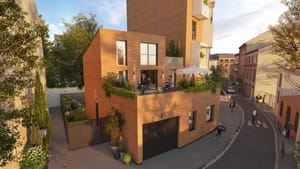
We understood that the term “efficiency” is not measured by maximum leasable space, but by the communication we encourage by building suitable areas. We try to create common areas which are best suitable for interactions by offering different sized multi-use areas. Our Project FUHUB in Berlin will offer terrace areas, various workshop spaces within the building and street workout and event areas in the outdoor facilities which will all be commonly used.
Location obviously plays a key role as well. Research and Development thrives in areas close to innovative companies, institutions and universities. FUHUB benefits immensely from being within the wider Freie Universität Campus and from being located within the FUBIC innovation cluster which is part of the so called “Zukunftsort Berlin Südwest”, one of 11 identified future innovation clusters within Berlin.
But it doesn’t end with the physical space. Even more important is how the occupiers are able to use communal areas once they move in. We always try to involve someone who actively pursues the idea of bringing occupiers together. In the end it always needs someone to pro-actively orchestrate in order to reach the maximum of potential synergies. At FUHUB and other developments of ours this role is played by a co-working company which is absolutely focused on doing just that.
What have we learned from COVID-19?
In a nutshell: we learned that with growing global population and the various economic challenges which exist throughout the world, diseases will occur more frequently and will be growingly difficult to tame. This, in turn, taught us that scientific research is as important as ever. We also learned that consequently every sector is impacted in one way or the other by these developments. In real estate we witnessed painful aspects such as the interruption of supply chains, an uncertainty of the future of office space and increasing construction costs. Therefore, building lab space to enhance scientific research does not only offer an interesting economic outlook but also a social impact which we enjoy, regardless of its scale in the wider global context.
What is the single thing that most clearly defines a DRIVEN property?
A DRIVEN property is best defined by its dedication to user friendliness. We are not trying to maximize the exclusive leasable space of each occupier. We rather try to design spaces which are commonly usable and enhance communication among the occupiers. We believe that shared areas will, in the end, also decrease the need for the amount of exclusively let space by the tenants which ultimately represents a far greater added value.
Could you tell me a little more about FUHUB and how it might differ from existing similar assets?
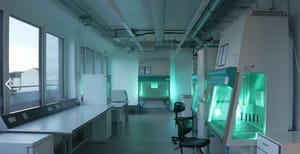
FUHUB is one of the very few speculatively developed lab buildings in Germany. I have already explained a few major unique selling points in terms of architecture and design of common spaces. Furthermore, FUHUB will be the first wood hybrid construction in Germany among lab buildings. We set very high standards in terms of ESG and aim for a DGNB Platinum Certificate. Among others we plan with rainwater retention, geothermal and solar energy, natural cooling systems and measures to enhance biodiversity on roofs, terraces and outdoor facilities. The entire cluster will be built on a “electricity only” 100 per cent renewable energy supply basis which is being developed in cooperation by the Rheinisch Westfälische Technische Hochschule Aachen (RWTH) and the Freie Universität Berlin (FU Berlin). Therefore, we believe that FUHUB differs in many different areas from existing assets.
Can you recall an event or incident that made you radically change your views on development?
I would say that gradual developments have changed my views rather than single events. The first discussions with a potential tenant for our FUHUB project were definitely a revelation towards life science real estate. We had these discussions in 2021. For a considerably long time we were planning FUHUB for a single tenant without the need for labs. Once this idea was overthrown due to changes in the timeline of that occupier, we were approached by a company which needed lab space. This was completely new for us, but we were very excited and started adjusting the design and technical planning. Once the number of changes and the specific needs became clear we decided very quickly to convert half of the building into lab spaces. We were very convinced that the need for lab space was far greater than for office space. The continuous discussions with further potential tenants confirmed our vision and the learning curve with each conversation was very steep.
We are now very much focused on developing lab space and are able to look at projects with a complete new and fresh perspective when evaluating potential uses